

SEER2 Ratings Explained for Florida Homeowners
Florida requires 15.2 SEER2 on split systems 45,000 BTU and larger in 2026. Here’s what the rating measures, how it maps to FPL bills, and where 16 to 18 lands.
If you’ve received a quote for a new air conditioner recently, you’ve likely seen a SEER2 number on the estimate and wondered how it maps to your FPL bill, your comfort during a Palm Beach County summer, and the state’s current code requirements. This guide breaks down what the rating measures, what Florida requires in 2026, and what delivers the strongest return in a climate where the compressor runs upward of 2,500 hours a year.
SEER2 stands for Seasonal Energy Efficiency Ratio 2. It measures cooling output per unit of electricity across a full season, and the higher the number, the less power a system draws to hit the same setpoint. Florida’s current federal minimum is 15.2 SEER2 for split systems rated 45,000 BTUs and larger, and 14.3 SEER2 for split systems under 45,000 BTUs. Most Boca Raton homeowners weighing a replacement this year land somewhere between 15.2 and 18 SEER2 depending on budget, home size, and how long they plan to stay.
What Does SEER2 Mean?
SEER2 stands for Seasonal Energy Efficiency Ratio 2, and it tells you how many BTUs of cooling a system delivers per watt-hour of electricity consumed across a typical cooling season. A 16 SEER2 system moves more cooling per kilowatt than a 14 SEER2 system, and that gap shows up on the FPL bill every month the compressor runs.
The 2 in SEER2 signals a change to the test procedure, not a change to the equipment itself. The Department of Energy updated its testing methodology on January 1, 2023 to reflect real-world duct conditions instead of the older lab-only benchmark. Same physical unit, more realistic score.
How SEER2 Testing Differs From the Original SEER Rating
The original SEER rating was calculated at 0.1 inches of water column of external static pressure, which is close to a lab bench with almost no duct resistance. The M1 test procedure used for SEER2 raises the static pressure to 0.5 inches of water column, which reflects the pressure a real residential duct system creates once the equipment is connected to a real house.
Because the new test is harder, SEER2 numbers run roughly 4 to 5 percent lower than old SEER figures for the same equipment. A unit that used to be marketed at 16 SEER now shows as about 15.2 SEER2. Readers new to efficiency labels can start with understanding traditional efficiency metrics like SEER, HSPF, and AFUE before comparing modern quotes side by side.
SEER to SEER2 Converter
Tap an old SEER number to see its approximate SEER2 equivalent.
The exact SEER2 figure for a specific system comes from the AHRI certificate for that matched indoor and outdoor coil pairing, not the marketing sheet on the outdoor unit alone.
What Is the Minimum SEER2 Rating in Florida for 2026?
The minimum SEER2 Florida 2026 code requires is 15.2 for split-system central air conditioners rated 45,000 BTUs and larger, and 14.3 for split systems under 45,000 BTUs. Split-system heat pumps also carry a 14.3 SEER2 minimum along with heating efficiency requirements measured in HSPF2. Single-package rooftop units have to hit at least 13.4 SEER2.
What Florida code requires in 2026
Florida falls into the Department of Energy’s Southeast region, which carries the strictest residential minimums in the country because cooling loads here are heavier than in most northern states.
Check the SEER2 figure on your quote
A contractor installing a system below these thresholds in Palm Beach County is not code compliant, and the equipment usually cannot be legally sold as new residential inventory. Any quote listing a lower SEER2 figure is worth a second look before you sign.
What Is a Good SEER2 Rating for a South Florida Home?
For most Boca Raton homes, a good SEER2 rating falls between 16 and 18. That range clears the federal minimum, delivers noticeable savings on the FPL bill, and often qualifies for federal tax credits and utility rebates without pushing equipment costs into premium territory. Homeowners staying in the house for a decade or longer usually find the math tilts further toward 18 SEER2 or higher.
Higher-tier systems also tend to use variable-speed compressors that run longer at lower capacity. In a summer that averages 85 to 90 percent relative humidity outdoors, that longer runtime is what pulls moisture out of the air and keeps indoor humidity below the 55 to 60 percent range where mold starts to become an issue.
SEER2
These units meet the current federal minimum and carry the lowest install price. Single-stage compressors deliver adequate cooling but weaker humidity control across a full South Florida summer.
Rentals & seasonal condosSEER2
Where most Palm Beach County homeowners land. The price premium over the federal minimum is modest, the monthly FPL savings are real, and 16 SEER2 is the threshold for the federal residential clean energy tax credit. Two-stage compressors are common at this tier.
Most Boca Raton homesSEER2
Inverter-driven variable-speed compressors ramp output continuously rather than cycling on and off. Electricity use drops noticeably and indoor humidity stays under 55 percent even during the wettest weeks of July and August.
Full-time residence, high billsHow Much Can a Higher SEER2 Cut Your FPL Bill?
Set what you have now against what you’re considering. Based on a 3-ton system running roughly 2,500 hours a year at the current FPL rate near $0.16 per kilowatt-hour.
Upgrading from a legacy 10 SEER system to a modern 16 SEER2 model can lower cooling electricity use by roughly 37 percent, which shows up on the monthly FPL statement. Boca Raton’s average residential electricity bill runs around $277 per month, and cooling accounts for most of the summer load, so the compounding savings across a 12- to 15-year system life often clear the price gap between a minimum-efficiency and mid-tier unit.
The table below estimates annual cooling costs for a 3-ton system running roughly 2,500 hours per year at the current FPL residential rate near $0.16 per kilowatt-hour. Actual figures vary with home size, insulation, thermostat setpoint, and duct condition, but the pattern holds across most Palm Beach County homes.
| SEER2 Rating | Estimated Annual Cooling Cost | Notes |
|---|---|---|
| 14.3 SEER2 | ~$1,010 | Federal minimum for smaller split systems |
| 15.2 SEER2 | ~$945 | Federal minimum for larger split systems |
| 16 SEER2 | ~$900 | Qualifies for federal tax credit |
| 18 SEER2 | ~$800 | Variable-speed comfort tier |
| 20 SEER2 | ~$720 | Premium efficiency, strongest humidity control |
Common SEER2 Models You’ll See on Boca Raton Estimates
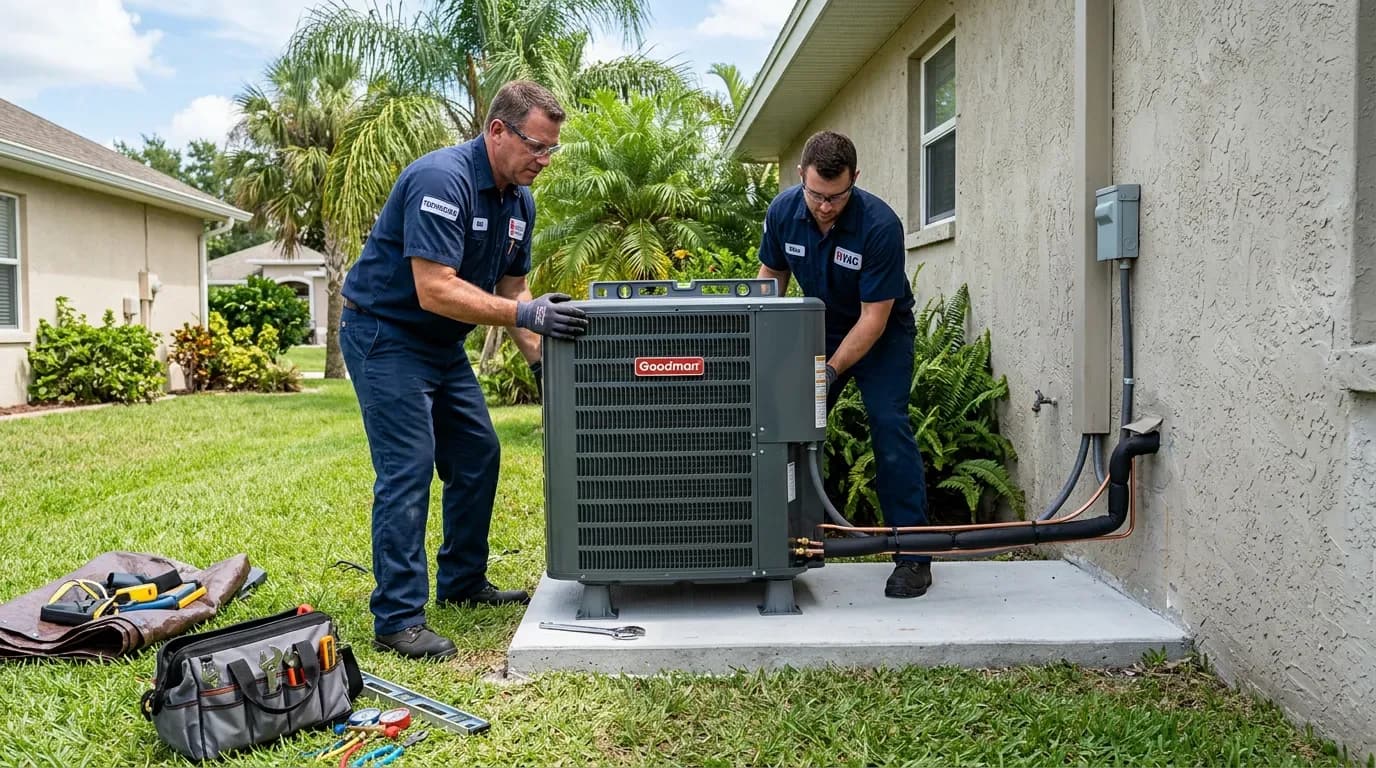
Most Palm Beach County replacement quotes come back with equipment from Carrier, Trane, Rheem, Lennox, Goodman, or Daikin. Each brand offers models across the efficiency spectrum, from federal-minimum single-stage units to premium variable-speed inverter systems rated at or above 20 SEER2. Coastal salt air is a real corrosion risk within five miles of the water, so coated-coil or coastal-series models are worth asking about on any Boca Raton install.
Here’s a snapshot of common model lines and their typical SEER2 ranges. Manufacturers refresh lineups regularly, and the SEER2 figure printed on the outdoor unit only reflects a certified rating once the AHRI certificate for the matched indoor and outdoor coil pairing confirms it.
| Brand | Common Model Lines | Typical SEER2 Range | Compressor Type |
|---|---|---|---|
| Carrier | Infinity 26, Infinity 19VS, Comfort 15 | 15.2 to 26 | Single-stage to variable-speed |
| Trane | XV20i, XV18, XR16 | 14.3 to 22 | Single-stage to variable-speed |
| Rheem | Endeavor Prestige, Endeavor Classic | 15.2 to 20.5 | Two-stage to variable-speed |
| Lennox | SL28XCV, XC21, EL16XC1 | 15.2 to 28 | Single-stage to variable-speed |
| Goodman | GSXV9, GSXC7, GSXH5 | 14.3 to 18 | Single-stage to two-stage |
| Daikin | DX20VC, Fit series | 15.5 to 20.6 | Inverter to variable-speed |
Do Federal Tax Credits and FPL Rebates Apply to High-SEER2 Systems?
Yes, and combining them is where the math starts to work in favor of a step up in efficiency.
Federal Credit · Central AC
For qualifying central air conditioners rated 16 SEER2 or higher.
Federal Credit · Heat Pump
For qualifying heat pump installations under the Inflation Reduction Act.
FPL Residential Rebate
On approved efficient systems. Program terms refresh annually.
The federal Energy Efficient Home Improvement Credit under the Inflation Reduction Act covers up to $600 for qualifying central air conditioners rated 16 SEER2 or higher, and up to $2,000 for qualifying heat pump installations. Florida Power & Light also offers a $200 residential AC rebate on approved efficient systems, and the program terms refresh annually.
Combining the federal credit with the utility rebate can offset several hundred dollars of the price difference between a minimum-efficiency and a 16 or 18 SEER2 unit. Homeowners weighing the numbers can review the available FPL rebates for Palm Beach County and use the online tool to calculate potential savings before requesting a formal quote.
Why SEER2 Alone Doesn’t Cut Bills if the System Is Sized Wrong
A high SEER2 rating only pays off if the system is right-sized and correctly installed. Oversized units are the most common install mistake in Palm Beach County, and they short-cycle before pulling enough moisture out of the air, which leaves the house feeling cool but clammy even at 74 degrees. Undersized units run continuously without reaching setpoint, push up electricity bills, and shorten compressor life.
A Manual J load calculation is the baseline for choosing the right tonnage. Duct condition, refrigerant charge, and thermostat setup all affect delivered performance, which is why the AHRI certificate for the matched indoor and outdoor coil pairing carries more weight than the sticker rating on the outdoor unit alone. A high-efficiency system installation done to spec delivers the SEER2 rating on the label. A rushed install rarely does.
Choosing the Right SEER2 Level for Your Boca Raton Home
The right SEER2 rating comes from matching efficiency to how long you plan to stay in the home, your current summer FPL bill, how much humidity control matters day to day, and which federal or utility incentives are on the table this year. Homeowners staying 10 or more years usually recover the cost of an 18 SEER2 or higher system through electricity savings, while shorter-term owners often do best with a 15.2 to 16 SEER2 unit.
For Boca Raton homeowners weighing a replacement, walking through the numbers against actual bill history is the fastest path to a confident decision. The Pro Comfort AC team covers local Boca Raton cooling requirements across the full efficiency range and matches SEER2 tier, tonnage, and refrigerant type to each home’s specifics before writing an estimate.
Match the SEER2 Tier to Your Actual Bill History
Pro Comfort AC runs the Manual J, checks the AHRI certificate on the matched coil pairing, and walks the numbers against your real FPL history before writing an estimate — so the rating on the label is the one you actually get.
Frequently Asked Questions
15.2 SEER2 for split-system central air conditioners rated 45,000 BTUs and larger, and 14.3 SEER2 for split systems under 45,000 BTUs. Split-system heat pumps carry a 14.3 SEER2 minimum plus HSPF2 heating requirements, and single-package rooftop units must hit at least 13.4 SEER2.
The test procedure, not the equipment. The DOE updated its methodology on January 1, 2023, raising external static pressure from 0.1 to 0.5 inches of water column to reflect real duct resistance. Because the new test is harder, SEER2 numbers run roughly 4 to 5 percent lower — a unit marketed at 16 SEER now shows as about 15.2 SEER2.
Between 16 and 18 for most Boca Raton homes. That range clears the federal minimum, delivers noticeable FPL savings, and often qualifies for federal tax credits and utility rebates without premium pricing. Homeowners staying a decade or longer usually find the math tilts toward 18 SEER2 or higher.
Yes. The federal Energy Efficient Home Improvement Credit covers up to $600 for qualifying central AC rated 16 SEER2 or higher, and up to $2,000 for qualifying heat pumps. FPL also offers a $200 residential AC rebate on approved efficient systems. Combining them can offset several hundred dollars of the price difference.