Leaving your Boca Raton home or condo empty for weeks or months? Keep the AC running, control indoor humidity, set up useful alerts, and have someone local who can get inside if something goes wrong.
There is no single thermostat setting that works for every vacant Florida home. Your equipment, property type, humidity control, building rules, and how quickly someone can respond all matter.
A good snowbird AC plan is less about finding one perfect temperature and more about leaving the home with the right settings, a working system, useful monitoring, and a clear response plan.
Start with one practical question: who can get into your home if the AC stops working?
A thermostat alert is not much help if you are hundreds of miles away and no one has permission to enter the property.
Before you leave, give a trusted local contact or property manager the information they may need:
Condo owners should also confirm how technicians are allowed into the building. Some properties require vendor registration, elevator reservations, front-desk approval, or other arrangements before anyone can reach the equipment.
Have the system checked while there is still time to deal with anything the technician finds. Scheduling HVAC maintenance a week or two before you leave gives you more room to address a weak capacitor, drainage problem, thermostat issue, or another developing fault before the home is empty.
A pre-departure visit should generally include:
Airflow and filter condition
Condensate drain and drain pan
Float switch operation
Thermostat settings and Wi-Fi connection
Electrical components
Cooling performance
Indoor humidity
Outdoor equipment, where access allows
The goal is simple: leave with an AC system that is cooling, draining, and responding normally rather than hoping a small unresolved problem lasts until you return.
No. Do not turn the AC off for an extended summer vacancy in South Florida.
Even when no one is home, the system still needs to remove heat and moisture from the indoor air.
Too much humidity can affect drywall, cabinets, wood flooring, furniture, electronics, and other materials inside the property. It also creates better conditions for mold and mildew.
Temperature alone does not tell you whether the home is protected. An AC can keep the space reasonably cool while still struggling to remove enough moisture. If the house already feels clammy while you are there, an AC that cools but does not control Florida humidity is worth addressing before you leave it unattended for several months.
There is no one thermostat setting that works for every snowbird home.
Around 78°F is a common starting point, with the thermostat fan set to Auto, but the right setting depends on how your particular property handles heat and humidity.
Several factors can change the answer — tap a card to see why each matters:
Shared walls, ventilation, equipment location, and building rules can affect cooling needs
Humidity control does not depend entirely on AC runtime
Longer, lower-speed cycles may remove moisture more effectively
Large windows and direct sun increase heat gain
Warm, humid outside air can enter the home
Wood, artwork, electronics, and instruments may be more sensitive to humidity
Faster alerts can help catch a problem earlier
Avoid raising the temperature dramatically simply because no one is home. A higher setpoint means fewer cooling cycles, which can also mean less moisture removal.
For a vacant South Florida property, keeping indoor relative humidity below 60% is an important goal. Roughly 50% to 55% is often a better target when the equipment can maintain it.
How easily the home reaches that range depends on the HVAC setup.
A Boca Raton condo with a small closet air handler and no separate dehumidifier may behave differently from a house with variable-speed equipment. In fact, variable-speed and single-stage AC systems handle Florida humidity differently, which is one reason the same thermostat setting can produce very different results from one property to another.
Your thermostat matters too. Some systems can respond directly to indoor humidity. Others only remove moisture while the AC is actively cooling.
Monitor temperature and humidity separately rather than assuming a normal thermostat temperature means the property is fine.
The basic goal is the same, but Boca Raton condo owners usually have more building-specific details to consider.
| Before You Leave | Condo | Single-Family Home |
|---|---|---|
| Technician access | May require front desk or HOA approval | Usually handled directly by owner or caretaker |
| Equipment access | May involve closets, balconies, rooftops, or shared systems | Indoor and outdoor equipment is usually privately accessible |
| Shared systems | Building engineer may need to be involved | Usually not applicable |
| Storm inspection | Association may handle common areas | Owner coordinates property inspection |
| Water or drain issue | Responsibility may depend on building rules | Owner coordinates HVAC, plumbing, or other service |
If the system is already nearing the end of its life, vacancy planning can also expose issues that matter when replacing an AC in a Boca Raton condo, including equipment access, building approvals, rooftop or balcony restrictions, and who controls shared components.
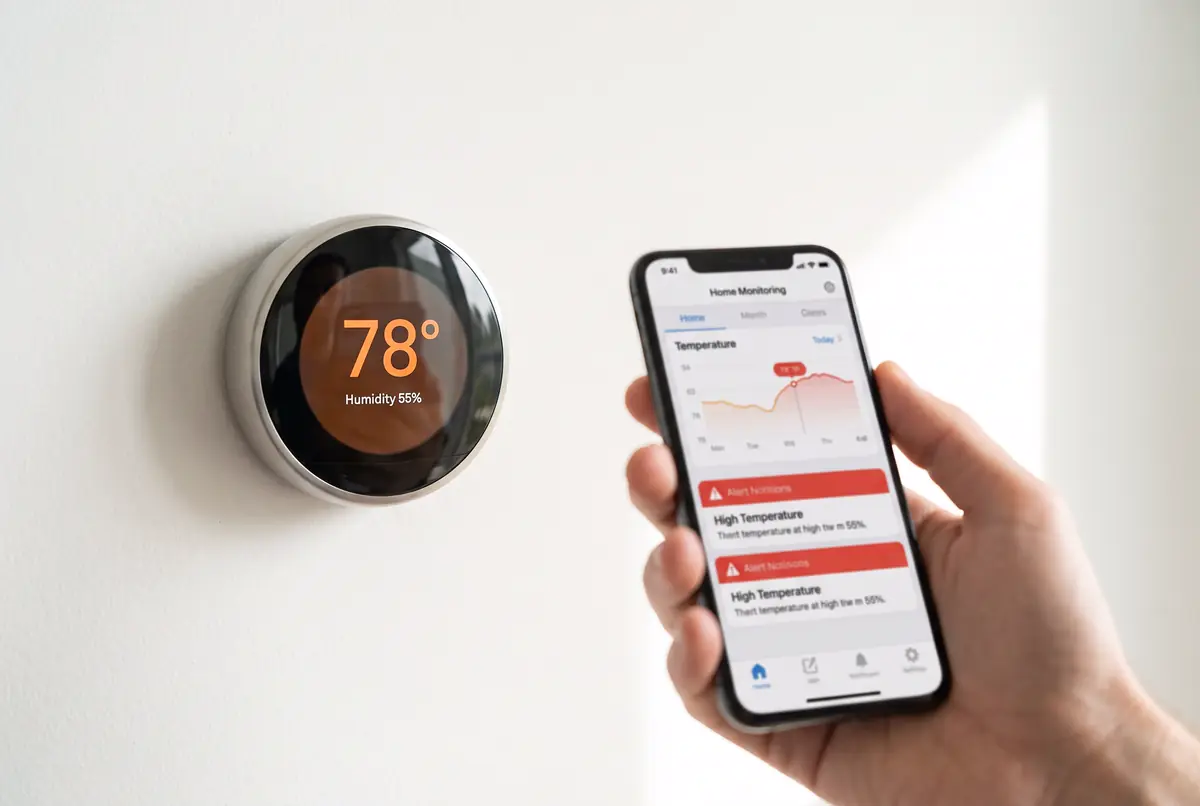
A smart thermostat can be very useful for a seasonal home, but you do not need a notification for every small change. Focus on alerts that tell you something has happened that may require a local response.
| Alert | What It Could Mean | First Step |
|---|---|---|
| Temperature stays unusually high | AC problem or power outage | Check thermostat and utility status |
| Humidity stays unusually high | Cooling or dehumidification problem | Arrange a local inspection |
| Water sensor detects moisture | Drain, plumbing, or other leak | Have someone inspect the area |
| Power goes out or returns | HVAC may need to restart | Confirm system and thermostat reconnect |
| Thermostat goes offline | Internet, power, or device problem | Ask a local contact to check |
| Equipment fault repeats | System may need service | Save the fault code and contact HVAC service |
Remote monitoring cannot prevent every problem. What it can do is shorten the time between something going wrong and someone responding to it.
Not necessarily.
Wi-Fi thermostats from brands such as Ecobee, Google Nest, and Honeywell Home can provide remote temperature readings, humidity information, vacation settings, and app alerts on many residential systems.
Some variable-speed systems use their own communicating controls instead. Condo equipment may also be tied into building systems that limit which thermostat can be installed.
Before changing the thermostat, confirm that the new control works with the HVAC equipment and does not conflict with any condo requirements.
If the AC stops while you are gone, first determine whether the property lost power or whether the HVAC system itself shut down.
Have your local contact look at the property before repeatedly resetting anything.
A tripped float switch, for example, often means water has backed up in the condensate drain or drain pan. The switch is there to stop the AC before that water overflows.
Do not bypass the switch simply to get the system running again.
Water around the indoor unit also deserves attention even if the AC still runs. An air handler dripping water can point to drainage, coil, airflow, or condensation problems that become much more serious when no one is home to notice them.
If the cause is not obvious, an AC repair technician can check the drain, electrical system, controls, airflow, refrigeration components, and other possible sources of the shutdown.
If water has already reached flooring, drywall, cabinetry, or another condo unit, address the water damage and building notification as well as the AC problem.
Seasonal owners also need a plan for what happens after a major storm or extended outage.
Your Boca Raton hurricane AC preparation should be in place before you leave, especially if the property will remain empty through the busiest part of hurricane season.
After an outage, confirm that power has returned, the HVAC system restarted, the thermostat reconnected, and indoor temperature and humidity are moving back toward normal.
If outdoor equipment was flooded, hit by debris, or visibly damaged, leave it off until a technician can inspect it.
There is no universal schedule. Your insurance policy, condo rules, equipment age, monitoring setup, and the condition of the property can all affect how often someone should visit.
A practical routine may look like this:
| Check | Typical Schedule |
|---|---|
| Review thermostat and sensor data | Weekly |
| Local caretaker or property-manager visit | Monthly or as required by insurance |
| Check or replace AC filter | Based on filter type and conditions |
| HVAC maintenance | Commonly twice per year |
| Storm-season equipment review | Before hurricane season |
| Review condo or HOA notices | As received |
Remote readings are helpful, but they should not completely replace an occasional physical inspection. A thermostat cannot tell you that water is staining the ceiling, the air handler is leaking, or an unusual smell has developed inside the home.
Do not immediately lower the thermostat by 10 degrees the moment you walk through the door.
First, see how the home and HVAC system performed while you were away.
When you return:
A system may run longer than usual while bringing a warm house back to your normal temperature. But if it keeps running without getting the home comfortable, understanding how long your AC should run in Boca Raton can help you separate a normal recovery cycle from a cooling problem that needs attention.
Before closing up the property for the season, focus on four things:
Keep the AC running at a reasonable setting
Control and monitor indoor humidity
Leave with the HVAC system working properly
Give someone local the access and authority to respond
The thermostat setting matters, but it is only one part of the plan. A seasonal Boca Raton home is much better protected when temperature, humidity, maintenance, alerts, and local access all work together.
If the system needs attention before an extended vacancy, scheduling HVAC service in Boca Raton before departure gives you time to deal with cooling, drainage, or control issues while you are still in town.
Every home cools differently based on size, layout, and insulation. During the consultation, we recommend energy-efficient systems from all major brands that fit your needs and budget. We handle everything from equipment selection to final testing, balancing upfront AC installation cost with long-term energy savings.
Central air conditioning is the most popular choice for South Florida homes. These systems use your existing ductwork to deliver consistent temperature throughout your house. We install units that balance powerful cooling with reasonable energy bills.
Ductless mini-splits let you control each room's temperature separately. Each unit works on its own, so everyone can set their preferred setting. They work well for room additions, converted garages, or homes without ductwork.
Upgrade your new system with a smart thermostat. We install and program the latest Wi-Fi thermostats from Nest, ecobee, and more, giving you total control over your home's comfort and energy use.
When upgrading your AC, your duct system matters just as much as the unit itself. Leaky or poorly insulated ducts waste cooling and drive up costs. Our duct services identify and fix problem areas to maximize efficiency.
Our HVAC technicians install, repair, and service all major brands. We stock parts for most manufacturers and can order components when needed.


Pro Comfort AC has built our reputation on honest service and quality workmanship. When you need reliable AC Installation in Deerfield Beach, FL, we do things the right way.

Our installers are state-certified and EPA-credentialed. They follow manufacturer specs and Florida building codes on every job.

You'll receive a detailed estimate that breaks down equipment costs, labor, and any additional work required. No hidden fees appear on your final invoice.

We offer financing plans that make it easier to afford the air conditioner replacement your home needs. Ask our team about available payment options during your consultation.

We stand behind our work. Every new AC unit installation includes a full year of warranty coverage on all installation labor, giving you confidence in your investment.
Quality brands we trust