A water-source heat pump in a Boca Raton condo works differently from the split AC systems found in many single-family homes. Instead of relying on a private outdoor condenser, the unit connects to a shared building water loop that helps carry heat away from your condo.
That shared setup changes how cooling problems are diagnosed, who may be responsible for repairs, and what needs to happen when the equipment is replaced.
If your condo has stopped cooling, the first question is not simply what broke? It is whether the problem is inside your unit or somewhere in the building system.
One of the easiest clues is the absence of a private outdoor condenser.
A water-source heat pump is usually installed in a utility closet, ceiling space, or similar indoor location and has water lines running directly into the cabinet. A traditional split system has an indoor air handler plus a separate outdoor condenser on a roof, balcony, ground pad, or other exterior area.
| Feature | Water-source heat pump | Traditional split AC |
|---|---|---|
| Private outdoor condenser | Usually no | Yes |
| Water lines connected to unit | Yes | No |
| Uses shared building system | Yes | No |
| Typical condo location | Closet or ceiling space | Indoor air handler plus outdoor condenser |
| Cooling depends on building loop | Yes | Mostly no |
If you are unsure what type of system you have, take a clear photo of the equipment nameplate. It usually shows the manufacturer, model number, capacity, voltage, and refrigerant type. That information can help identify the system before a service visit is scheduled.
A water-source heat pump uses the same basic refrigeration principles as other heat pump systems, but instead of exchanging heat with outdoor air, it transfers heat through water circulating in the building loop.
During cooling, your condo's heat pump removes heat from indoor air and transfers it into the shared water loop. The building then uses equipment, often including a cooling tower, to manage that heat.
In heating mode, compatible systems can reverse the process and pull heat from the loop back into the condo.
Because the unit depends on the shared loop, a cooling problem may not be limited to the equipment inside your condo. Water temperature and water flow in the building system can directly affect how well the heat pump performs.
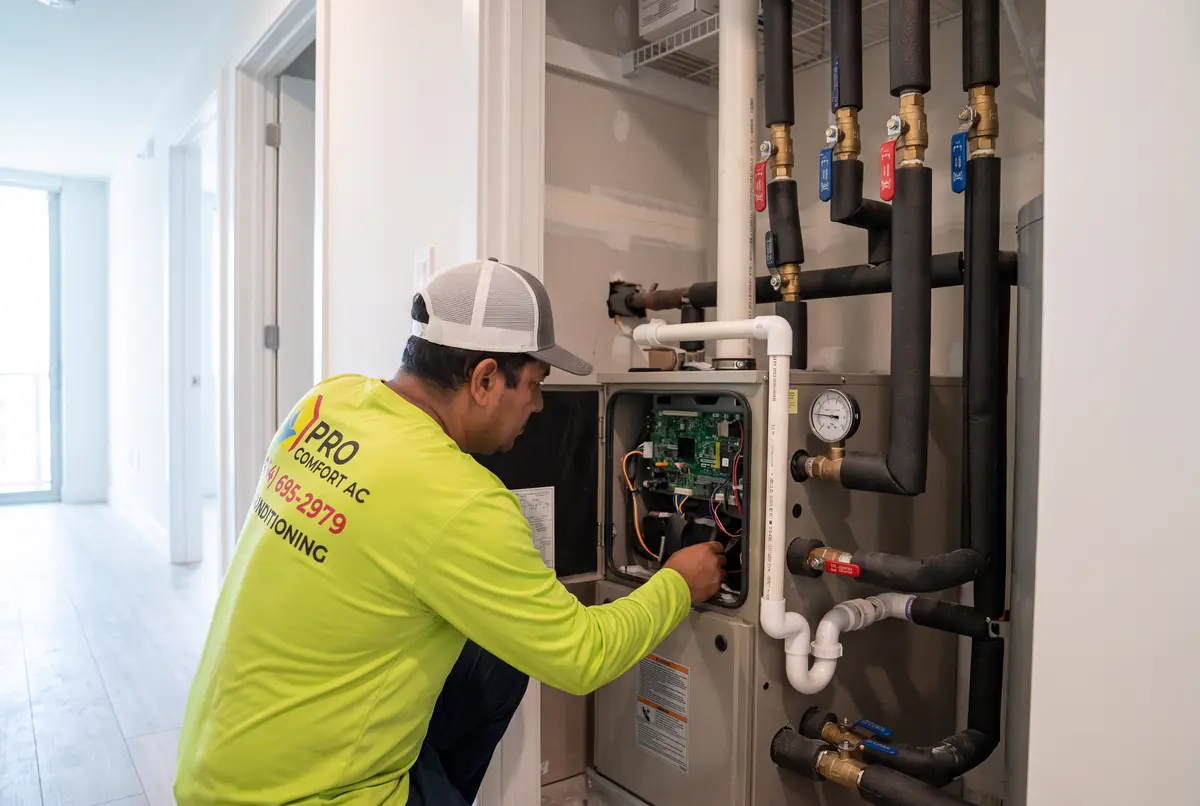
The dividing line varies by condominium, but the equipment inside your condo is generally separate from the shared system serving the building.
Isolation valves, hoses, strainers, piping immediately around the cabinet, and access responsibilities can fall on either side depending on the building.
Before approving a major repair, check the association's rules or ask management where owner responsibility ends. This matters particularly when the symptoms could come from either your condo equipment or the building's shared cooling system.
Start by finding out whether anyone else is having the same problem.
If only your condo has lost cooling, the issue is more likely to be inside your unit or close to it. If several condos on the same floor, riser, or multiple floors are affected at the same time, the building loop becomes a much stronger suspect. Tap a card to see what it may point to.
Thermostat, airflow, controls, refrigerant, compressor, local valve or strainer
Loop temperature, water flow, pumps, cooling tower, boiler or other common equipment
Airflow, controls, refrigerant issue, poor water flow or high loop temperature
Condensate issue, local water connection or nearby building piping
If management has already reported a cooling tower, pump, or building-loop problem, that information should be part of the diagnosis before anyone recommends replacing your individual heat pump.
When several units are affected, building management may also need a contractor who works with shared and multi-unit HVAC equipment rather than treating each condo as a separate repair call.
A water-source heat pump service call should look at both the refrigeration side of the unit and the water conditions affecting it.
Depending on the equipment and available access, a technician may check:
Thermostat operation and stored fault codes
Filter, blower, airflow, and coil temperature difference
Refrigeration performance
Entering and leaving water temperature
Water flow, valve position, and strainer condition
Condensate drainage and overflow protection
Recent building notices or known loop problems
Water-side information matters because a shared-loop problem can produce symptoms that look like a failing heat pump.
If the problem appears limited to your condo, the next step is usually diagnosing the AC equipment serving your unit while still accounting for the building loop.
No. Matching the tonnage is only one part of choosing a replacement.
A new water-source heat pump also needs to work with the physical space, electrical setup, water connections, airflow requirements, controls, and building loop.
Important compatibility checks include:
Closets and ceiling spaces in condo buildings can leave very little room for changing cabinet dimensions or connection locations. Before equipment is ordered, a proper AC replacement assessment should confirm that the new unit will work with the existing space and system.
Refrigerant is another consideration when replacing older equipment. The transition away from new R-410A equipment does not mean an existing system has to be replaced simply because it uses R-410A. It does mean refrigerant type and equipment compatibility belong in the conversation when a major repair or replacement is being considered. The changes affecting R-410A equipment in 2026 are especially relevant when comparing newer replacement options.
Repair often makes sense when the main equipment is still in good condition and the problem is limited to a replaceable component.
Replacement becomes more reasonable when you are dealing with major compressor or heat-exchanger failure, corrosion, outdated controls, limited parts availability, or repeated repairs on an aging system.
But there is an important exception: do not replace an individual condo unit simply because a shared building problem is affecting its performance. If loop temperature or water flow is outside the proper range, a brand-new heat pump could face the same problem.
For an older system with a costly repair ahead, weighing AC repair against replacement can help frame the decision. With a water-source heat pump, that comparison should happen only after the building loop has been ruled out as the cause.
Replacing the equipment itself may be only one part of the project.
Many Boca Raton condo buildings have their own requirements for contractor access, work hours, insurance documentation, water shutoffs, equipment movement, and protection of common areas.
Depending on the building and project, you may need to coordinate:
These extra steps are one reason replacing AC equipment in a condo often takes more coordination than replacing a similar system in a single-family home.
Permitting can affect the schedule as well. If replacement is already on the table, understanding when an AC installation requires a permit can help you plan the project before installation dates are set.
Maintenance is usually divided between the condo owner, the HVAC technician, and building management.
Regular HVAC maintenance for the equipment inside your condo can help catch developing problems, but it does not replace maintenance of the shared water loop.
Both sides need to be operating properly for the system to cool as intended.
A few details can save time when you call for water-source heat pump repair in Boca Raton.
Try to have:
The most useful detail may be whether the problem is limited to your condo. That one piece of information can quickly change the direction of the diagnosis.
Water-source heat pumps are common enough in condo buildings to look straightforward, but the shared loop changes the way repairs and replacement decisions need to be approached.
If you need service, start by identifying whether the problem is limited to your unit and share any building notices with the technician. HVAC service in Boca Raton is available for condo owners who need help diagnosing, repairing, maintaining, or replacing their equipment.
Every home cools differently based on size, layout, and insulation. During the consultation, we recommend energy-efficient systems from all major brands that fit your needs and budget. We handle everything from equipment selection to final testing, balancing upfront AC installation cost with long-term energy savings.
Central air conditioning is the most popular choice for South Florida homes. These systems use your existing ductwork to deliver consistent temperature throughout your house. We install units that balance powerful cooling with reasonable energy bills.
Ductless mini-splits let you control each room's temperature separately. Each unit works on its own, so everyone can set their preferred setting. They work well for room additions, converted garages, or homes without ductwork.
Upgrade your new system with a smart thermostat. We install and program the latest Wi-Fi thermostats from Nest, ecobee, and more, giving you total control over your home's comfort and energy use.
When upgrading your AC, your duct system matters just as much as the unit itself. Leaky or poorly insulated ducts waste cooling and drive up costs. Our duct services identify and fix problem areas to maximize efficiency.
Our HVAC technicians install, repair, and service all major brands. We stock parts for most manufacturers and can order components when needed.


Pro Comfort AC has built our reputation on honest service and quality workmanship. When you need reliable AC Installation in Deerfield Beach, FL, we do things the right way.

Our installers are state-certified and EPA-credentialed. They follow manufacturer specs and Florida building codes on every job.

You'll receive a detailed estimate that breaks down equipment costs, labor, and any additional work required. No hidden fees appear on your final invoice.

We offer financing plans that make it easier to afford the air conditioner replacement your home needs. Ask our team about available payment options during your consultation.

We stand behind our work. Every new AC unit installation includes a full year of warranty coverage on all installation labor, giving you confidence in your investment.
Quality brands we trust