

Why Are More South Florida Businesses Choosing Commercial Split Systems?
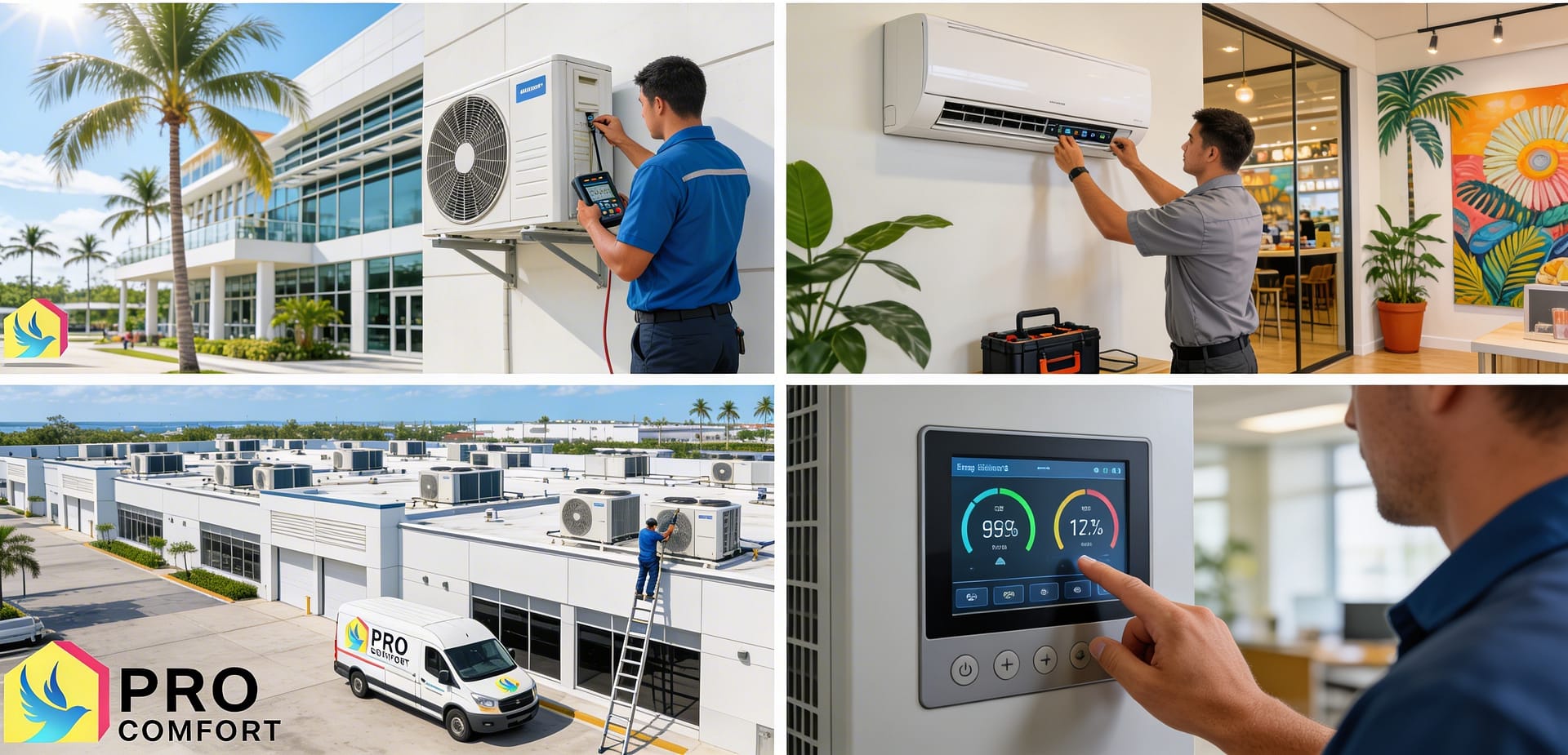
Beyond the Default Rooftop Unit
Most business owners assume that commercial HVAC means a big unit bolted to the roof. For a lot of buildings, that works. Rooftop packaged units have been the default for decades, and they handle plenty of commercial cooling loads well. But the assumption that they are the right answer for every building has sent a lot of property managers and business owners down a path that ends up being louder, more expensive, or more complicated than it had to be.
Understanding the Split System Configuration
Toggle between views to see how each system type is configured
How Does a Commercial Split System Work?
The setup is simpler than it sounds. Components are separated for optimal placement and reduced interior noise.
Evaporator coil, blower fan, pushes conditioned air through space
Compressor (noisy), releases heat outside building
An outdoor condenser unit handles the compressor and releases heat outside the building. An indoor air handler pulls return air across an evaporator coil and pushes conditioned air through the space. Refrigerant lines connect the two through a small wall penetration. It doesn’t require no large roof curb, no structural modifications, no ductwork overhaul needed.
Packaged Rooftop Unit Configuration
All components housed in one cabinet mounted on the roof or at ground level.
Compressor, evaporator coil, condenser coil, and blower fan all in one cabinet. Typically mounted on roof with ductwork running through ceiling.
Compare that to a packaged unit, where the compressor, coil, and blower all live in one cabinet on the roof or at ground level. With a split configuration, each component goes where it makes sense for the building. That placement flexibility is what drives most of the benefits.
How Split Systems Perform for South Florida Commercial Buildings
Capacity Ranges Worth Knowing Before You Buy
Single-zone units used in small offices, server rooms, retail kiosks, and similar spaces. Compact, low installation complexity, and easy to service.
This is the core range for most South Florida commercial applications including medical clinics, multi-room offices, restaurants, and mid-size retail. Systems in this range support multi-split configurations, cooling-only and heat pump versions, programmable scheduling, and remote monitoring. New installations use R-454B refrigerant, with R-410A units available for replacement compatibility in existing systems.
Suited to larger or more demanding cooling loads. These units are BMS-compatible and configurable with or without an integrated compressor. At this scale, it is worth evaluating the building’s zoning requirements carefully before committing to a split system versus a VRF approach.
For facilities where all-electric heat pump operation is not the right fit, gas furnace and indoor coil pairings handle cooling alongside gas heat. These configurations cover BTU ranges from 40,000 to 120,000.
Equipment Commonly Installed Across South Florida
Commercial split systems here are typically drawn from manufacturers with track records in high-humidity, high-cycling environments.
Carrier
The 40RUA/38AUS light commercial line covers 3 to 25 tons with strong SEER2 ratings and BACnet connectivity for building management integration.
Trane
The Intellipak and 4TTB series handle light to mid-range commercial loads. Compressor warranties are solid, and parts availability across Florida is reliable.
Daikin
A well-established choice for multi-split configurations. The VRV-S line sits in a useful position between traditional split systems and full VRF setups for buildings with several zones.
Mitsubishi Electric
The City Multi and CITY MULTI R2-Series are widely installed in medical, legal, and multi-tenant office settings where low noise levels and independent zone control are non-negotiable.
Lennox
The HS26 and Merit commercial series appear frequently in restaurant and retail fit-outs across Broward and Palm Beach counties.
Equipment selection comes down to the building’s electrical service, tonnage requirements, refrigerant compatibility with anything already in the system, and the specific demands of each zone.
What the Installation Process Looks Like
Scope varies considerably by building. A single-zone replacement in a small office is typically a one-day job. Multi-split configurations involving several air handlers, new refrigerant line sets, and electrical work for three-phase service take longer and require coordination with the property’s electrical contractor.
All commercial installations should meet Florida Building Code requirements and be performed by licensed technicians. Load calculations, equipment selection, line set routing, electrical coordination, startup, and commissioning are all part of a complete installation, not optional add-ons. On-site assessments for new installations and replacements are the right starting point before any equipment is ordered.
Getting to the Right Answer for Your Building
Rooftop units are the right call for many South Florida commercial buildings with flat roofs, open floor plans, and single-zone cooling needs. That hasn’t changed. But treating them as the default has led businesses into systems that cost more to run, generate noise complaints, or require modifications that were never in the budget.
The better starting point is the building itself. What does the roof look like? How many zones does the space need? Are there tenants with different temperature requirements? Those answers usually point to the right system before any equipment gets selected.
For many commercial properties, a split system installed and sized for the specific building ends up being the better fit. Not because it’s the newest option, but because it matches how the building works.
Commercial Split System Installation & Service
Not sure if a split system or rooftop unit is right for your building? Our commercial HVAC team provides on-site assessments throughout Broward and Palm Beach counties to help you make the right choice.