

Why Packaged HVAC Units Power South Florida Businesses?
The Workhorse of Commercial HVAC
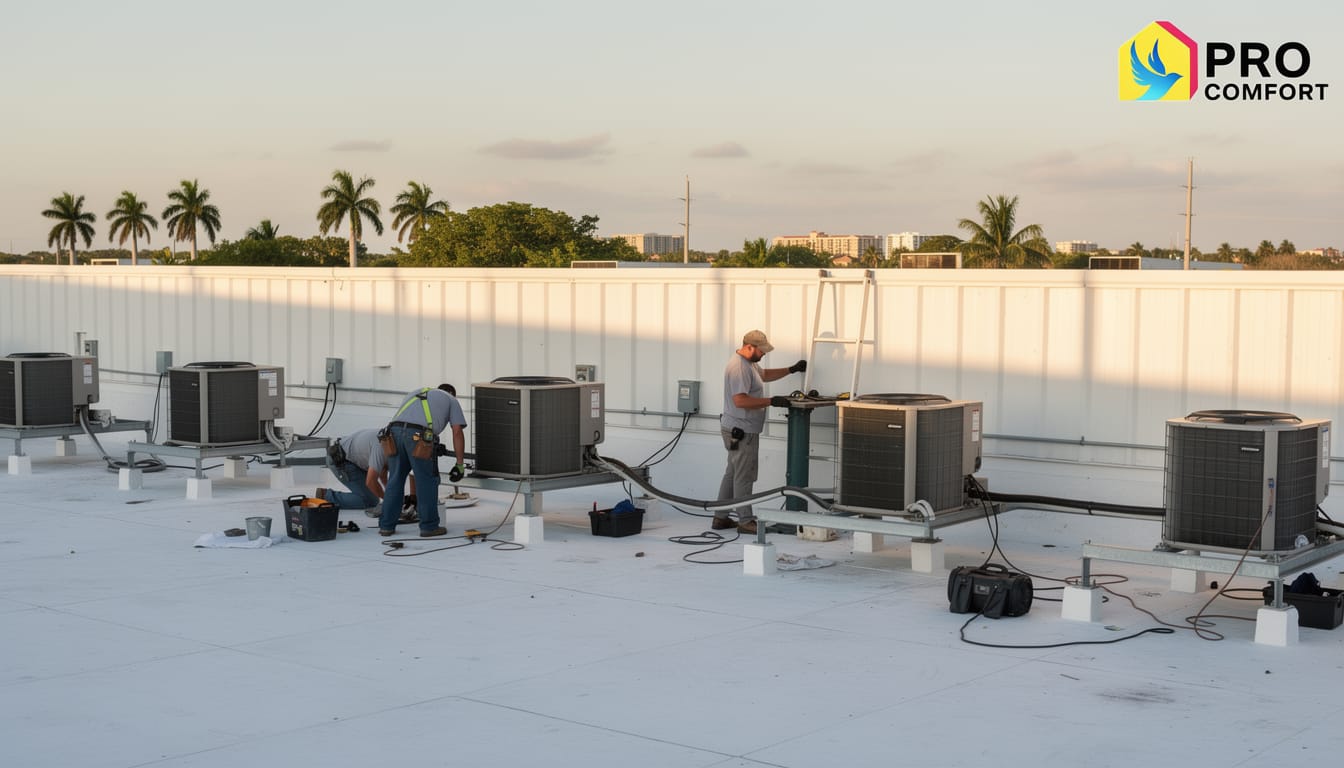
Look at any flat commercial roof across Broward or Palm Beach County and you’ll spot them. Large metal cabinets anchored above strip malls, restaurants, and office suites. Those are commercial packaged HVAC units, and they quietly keep the majority of South Florida’s businesses cool and functional year-round.
What Is a Commercial Packaged HVAC Unit and How Does It Work?
All major components housed in a single factory-assembled cabinet
Complete Packaged System
All components in ONE outdoor cabinet
A packaged HVAC system houses every major component inside a single factory-assembled cabinet. The compressor, condenser coil, evaporator coil, and air handler all live together in one outdoor unit. Refrigerant lines, electrical connections, and ductwork all terminate at the same location. That’s what separates it from a commercial split system where the indoor and outdoor equipment are installed separately, with refrigerant lines running between two distinct units.
Note: The term “Rooftop Unit” or RTU refers to where most packaged systems are mounted, not a different product category. South Florida’s flat-roof commercial construction lends itself to rooftop placement because it keeps mechanical equipment off the ground and out of the way of daily foot traffic.
Why Do So Many South Florida Businesses Rely on Packaged Units?
They Recover Usable Space Inside the Building
Every square foot inside a retail store, restaurant, or warehouse either generates revenue or supports the work happening there. Putting the entire HVAC system on the roof or on an exterior concrete pad means none of that interior space gets dedicated to equipment closets or indoor air handlers. For a restaurant in Deerfield Beach or a multi-suite office building in Boca Raton, that recovered floor space has direct financial value.
Technicians Can Service the Equipment Without Entering the Building
All components share one location, so technicians work on the roof or at the pad, not inside the dining room or sales floor. Routine inspections, coil cleaning, and most repairs get handled without interrupting operations. For businesses that stay open during the day, that separation between service work and customer space matters.
Factory Assembly Means Consistent Quality Out of the Box
Packaged units are built and tested in a controlled manufacturing environment before they ever leave the facility. By the time a unit is installed on a roof curb, it has already been verified to factory standards. Installation focuses on placement, electrical connections, and ductwork tie-in rather than assembling a system piece by piece on-site.
Common Commercial Buildings in Broward and Palm Beach Counties That Use RTUs
Rooftop packaged units installed on flat-roof commercial buildings are the standard across nearly every property type in this region.
South Florida’s flat-roof commercial construction and packaged HVAC systems developed alongside each other over decades. The building style and the equipment type fit together by design.
How to Size a Commercial Packaged Unit for Your Building?
An undersized unit runs constantly, struggles to hold temperature, and wears out faster than it should. An oversized unit short-cycles, turning on and off before completing a full run, which leaves behind persistent humidity problems and puts unnecessary stress on the system. Neither situation produces the comfortable, cost-effective conditions a business depends on.
Critical Sizing Factors
- Square footage
- Ceiling height
- Insulation quality
- Occupancy levels
- Window area and orientation
- How the space is used (e.g., restaurant kitchen vs. retail)
A Fort Lauderdale restaurant with a commercial kitchen carries a very different heat load than a similarly sized retail suite. Square footage alone is not a reliable basis for selecting tonnage, and a thorough load calculation before equipment selection is worth the time upfront.
Wind Load Standards and Hurricane Compliance for Rooftop Units in South Florida
Wind resistance is a baseline code requirement for rooftop equipment in Florida, not an optional feature. Commercial RTU installations must meet Florida Building Code wind load and hurricane tie-down standards. The unit is mechanically fastened to a roof curb, and the curb itself is anchored to the building structure.
For a property owner, that means the equipment on your roof is engineered to stay in place through a major storm, not simply set there and hoped for the best.
Installation Requirements: Crane coordination, rigging, permitting, and code compliance are all part of a complete commercial rooftop installation across Broward and Palm Beach counties.
How South Florida’s Climate Affects Packaged Unit Lifespan and Maintenance Needs
The climate here accelerates wear on outdoor equipment in ways that most other regions don’t experience. Salt air corrodes coil fins. Biological growth builds up faster in sustained humidity. Dust loads clog filters more frequently than in drier climates. A unit that runs for years without service will show it, typically during peak summer heat when demand is highest.
Expected Lifespan
Most commercial packaged units in this region last 12 to 15 years under consistent maintenance. Systems that go without regular inspections tend to fail earlier and carry higher repair costs before replacement becomes unavoidable.
The System Running Your Business Deserves Attention
The packaged unit on your roof manages humidity, air circulation, and air quality alongside temperature. For any commercial space where customers and staff spend time, that system affects the experience inside far more than most people consider.
Understanding what type of system you have, how it’s sized, and what it requires to stay reliable is part of running a commercial property well. Work with a qualified commercial HVAC contractor who understands Florida’s climate and code requirements, and your rooftop equipment will take care of the rest.
Commercial Packaged Unit Service & Installation
From new installations to routine maintenance, our commercial HVAC team handles packaged units throughout Broward and Palm Beach counties. We understand South Florida’s climate, building codes, and what it takes to keep your business comfortable.