

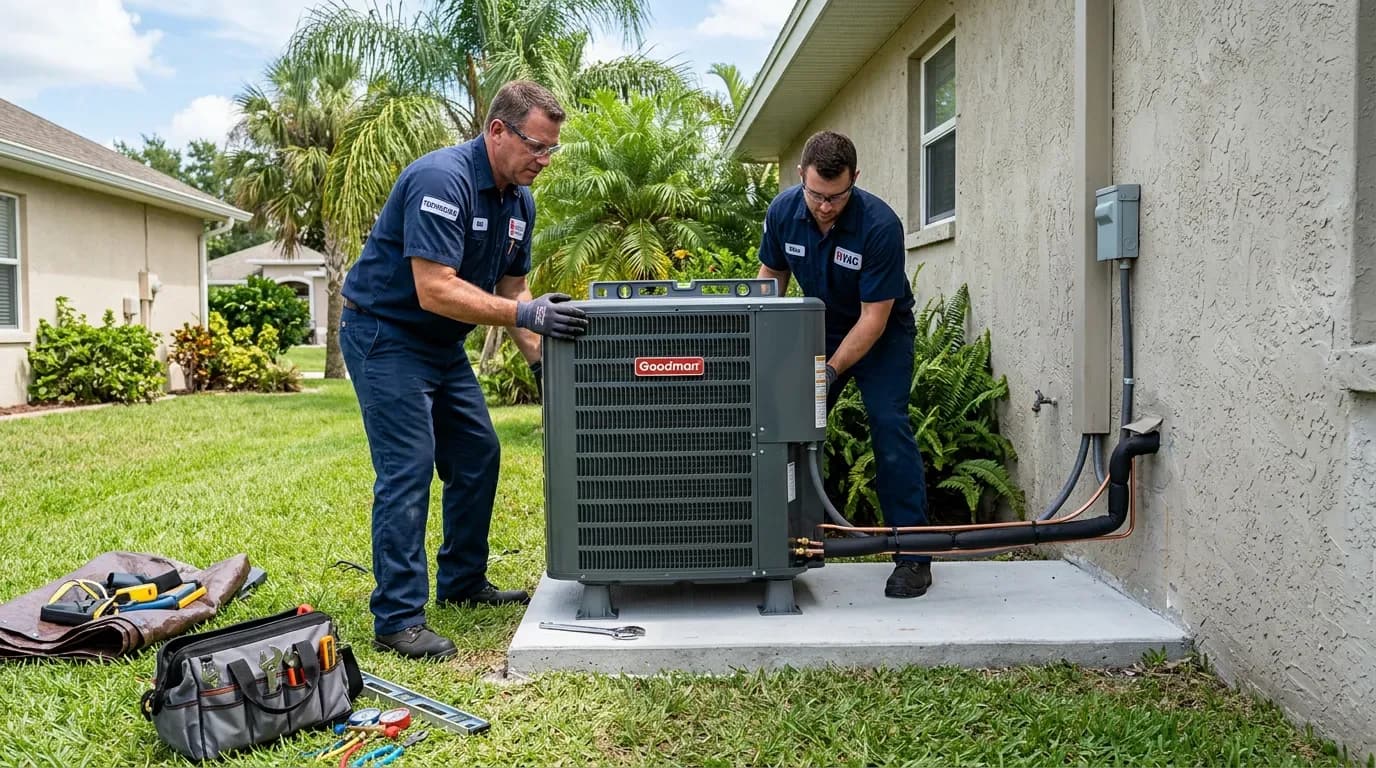
What to Expect During the AC Replacement Process
A standard AC replacement in Boca Raton runs 4 to 8 hours, with cooling off for 2 to 4. Here’s the five-phase timeline, permit steps, and what to expect on the day.
Replacing a central AC is a big decision, and most Boca Raton homeowners want a clear picture of what installation day looks like before signing anything. This guide walks through the timeline, the paperwork, the noise, and the small details South Florida crews handle differently because of the local climate and Palm Beach County permitting rules.
How Long Does AC Installation Take in a Boca Raton Home?
A standard central AC replacement takes between 4 and 8 hours from arrival to walkthrough. Jobs involving new ductwork, an equipment relocation, or full electrical upgrades usually run 1 to 2 days. Your cooling will typically be off for around 2 to 4 hours during the equipment swap itself.
Timing depends on the type of system, the condition of the existing lineset and ductwork, and access to the attic or garage where the air handler lives. A team already familiar with the AC installation process for Palm Beach County homes tends to move faster because they know the local building codes and how inspection scheduling actually flows.
What Happens Before Installation Day?
The pre-install phase covers a Manual J load calculation, equipment ordering, and a Palm Beach County permit pull. All of this happens in the days leading up to installation so the crew shows up with the right unit, the right materials, and clearance to begin.
The load calculation looks at square footage, ceiling height, insulation levels, sun exposure, and glass area. A South Florida home with a wall of west-facing sliders needs a different tonnage than a shaded two-story on the same street. Getting this number right prevents the short-cycling problems that leave homes feeling cold but sticky. Homeowners who want a fuller sense of what to weigh at this stage often find it useful to review preparation for a new system before the pre-install meeting.
Do I Need a Permit for AC Replacement in Florida?
Yes. Palm Beach County requires a mechanical permit for any central AC change-out. The contractor pulls the permit under their license, schedules the inspection, and submits the required paperwork on your behalf.
Skipping the permit costs more later
It can void manufacturer warranties, create issues at resale, and expose homeowners to fines. A full breakdown of local permit requirements covers what the county reviews and how long approval usually takes.
What the Install Day Looks Like, Phase by Phase
A standard install day breaks into five phases a well-run crew moves through in sequence. Tap a segment to see what happens — the bar is scaled to typical duration.
Arrival and setup
30 to 60 minutesCrew confirms placement, lays drop cloths, protects flooring and walkways.
| Phase | Estimated Time | What Happens |
|---|---|---|
| Arrival and setup | 30 to 60 minutes | Crew confirms placement, lays drop cloths, protects flooring and walkways |
| Old unit removal | 1 to 2 hours | Old refrigerant recovered, condenser and air handler disconnected and hauled out |
| New equipment set | 2 to 3 hours | New air handler mounted, new condenser placed and leveled, linesets connected |
| Electrical and controls | 1 hour | Wiring, disconnect box, thermostat installation, control board configuration |
| Testing and handover | 30 to 60 minutes | Startup, refrigerant charge verification, walkthrough with homeowner |
Every phase depends on what came before it. Rushing setup usually costs time later during testing, which is why experienced crews take the arrival stage seriously.
How Is the Old Refrigerant Handled?
EPA 608 rules require certified technicians to recover the refrigerant from the old system into a sealed recovery tank before anything gets disconnected. Venting refrigerant is illegal and carries significant fines. The recovered gas goes back to a licensed reclamation facility, which matters even more this year as R-410A supply tightens under the 2025 manufacturing ban.
How Does the New Air Handler and Condenser Get Installed?
The new air handler goes into the same location as the old one in most cases, either in an attic, a garage closet, or a utility area. The condenser slides onto a fresh pad with vibration isolation feet to keep the unit level and quiet. Line sets get sized to match the new system, and a nitrogen pressure test confirms the joints are sealed before refrigerant enters the loop.
Homes converting from a central system to a ductless setup follow a different sequence. Those projects involve wall-mounted indoor heads, small refrigerant lines routed through exterior walls, and often no ductwork changes at all. The mechanics behind ductless system installations look different from a traditional central swap, and the timing can shift accordingly.
What Do the Electrical and Thermostat Connections Involve?
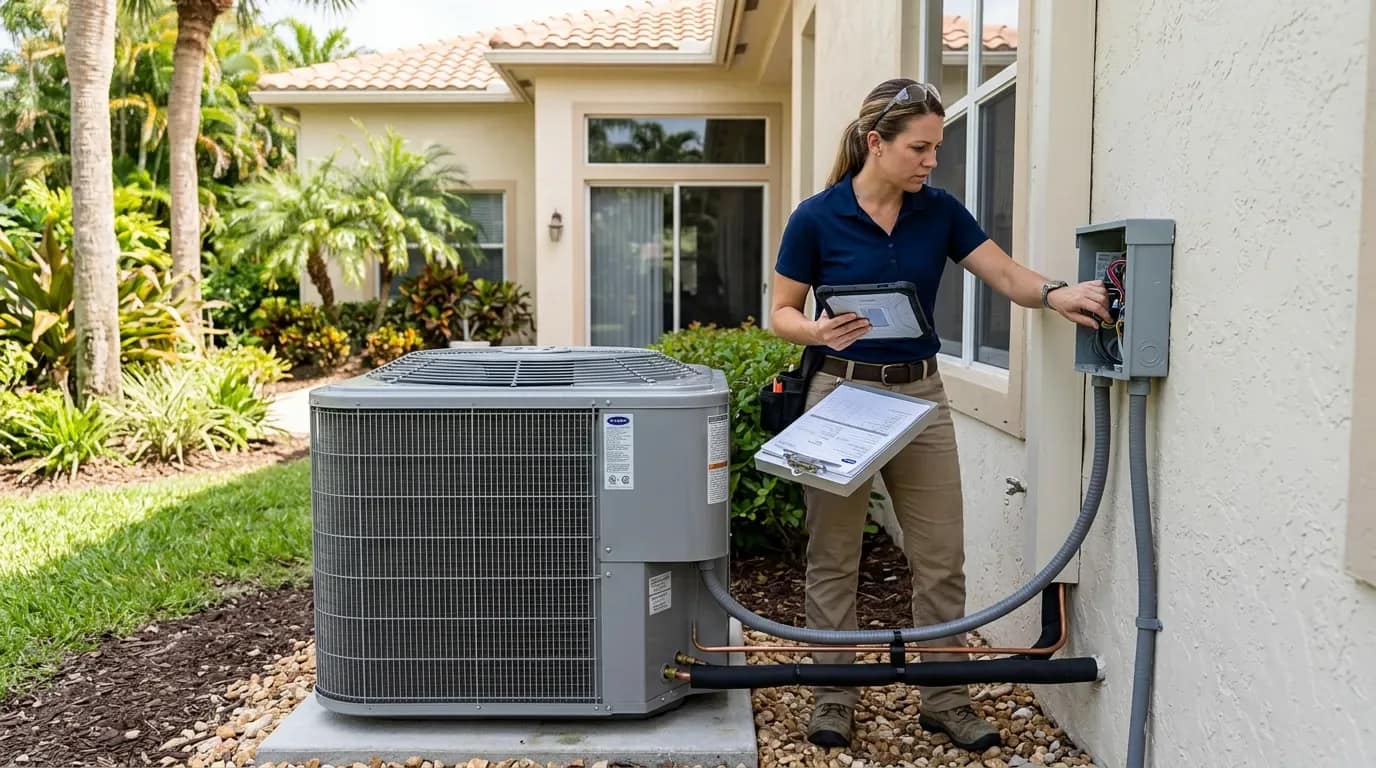
A licensed electrician handles the disconnect box, the whip to the condenser, and any breaker changes required for the new equipment. Modern variable-speed systems draw less current than older single-stage units, but they need a specific breaker size and wire gauge to match the manufacturer’s spec. The thermostat gets wired last, paired to the air handler, and configured for the correct system type before startup.
How Long Will My Power Be Off During AC Replacement?
Cooling is typically off for 2 to 4 hours during the equipment change-out itself. The rest of the day, the crew works on connections, testing, and finishing tasks with the system either running in test mode or fully back on. Households sensitive to heat can plan errands during that middle window.
In a Boca Raton summer, indoor temperatures climb quickly once the AC shuts down. Crews time the shutdown around the vacuum and charging window so cooling comes back as soon as pressures stabilize. Homeowners with pets or medical needs can request an early morning start, which keeps most of the no-cooling stretch inside the cooler part of the day. Contractors serving Boca Raton usually build this into scheduling by default during the June through September window.
What Happens After the New System Is Installed?
Post-install work covers system testing, the Palm Beach County inspection, and a short break-in period. The crew verifies airflow, static pressure, and refrigerant charge, then walks the homeowner through thermostat operation before leaving.
The county inspection usually happens within a few business days of installation. An inspector checks the permit, verifies the equipment matches what was filed, and looks at electrical connections, condensate routing, and clearances. Passing the inspection closes out the permit and finalizes warranty registration. For roughly 24 hours after startup, small adjustments in cycle length are normal as the system settles into your home’s load pattern.
Which AC Models Get Installed Most Often in Boca Raton?
Coastal Florida installations lean toward brands with strong corrosion resistance, high SEER2 performance, and dependable local parts availability. The models that show up most often in Palm Beach County replacements come from a familiar group of manufacturers.
Carrier and Bryant offer coastal-rated units with factory coil coatings, which matter for homes within a few miles of the water. For variable-speed operation and strong humidity control, Trane and American Standard remain popular choices. Rheem and Ruud tend to give the best dollar-for-dollar value on mid-tier equipment, while Lennox performs well at the high-efficiency end of the SEER2 range. Goodman and Amana serve budget-conscious replacements with reasonable warranty coverage. On the ductless side, Daikin and Mitsubishi lead the category, and York and Coleman round out the field with widely available parts.
The right brand for your home depends on the load calculation, the age of your ductwork, and if you want single-stage, two-stage, or variable-speed operation. A professional installation process starts with matching equipment to the house rather than defaulting to a favorite brand.
What Should Homeowners Do to Prepare?
A short prep list keeps the day moving and lowers the chance of last-minute surprises. Most of it takes less than an hour the evening before installation.
The Night-Before Checklist
Check these off as you go.
- Clear a path from the front door to the air handler location, including any garage or attic access
- Move stored items away from the outdoor condenser pad and trim back shrubs within a two-foot radius
- Plan for pets to stay in a closed room away from the work zone, since crews open exterior doors repeatedly
- Have a copy of your current thermostat schedule handy if you want the new one programmed the same way
Everything else is handled by the crew, including drop cloths, floor protection, and cleanup at the end of the day.
Is It Normal for a New AC to Run Constantly at First?
A new system often runs longer during the first day or two, especially if installation happened during a hot afternoon and the house had already warmed up. Once the indoor temperature reaches the setpoint, a correctly sized unit should cycle on and off rather than run without a break.
Variable-speed systems behave differently from older single-stage units. They run for longer stretches at lower capacity, which is what pulls more moisture from the air. That extended runtime is expected and is the reason indoor humidity drops noticeably in the first week. If the system runs nonstop for more than 24 hours without hitting the setpoint, it’s worth calling the installer for a charge and airflow check before scheduling anything else.
What Sets a Good Installation Apart?
The details that separate a clean install from a messy one usually come down to preparation. A crew that has walked the property before installation day, confirmed the equipment fit, and pre-scheduled the county inspection tends to finish on time and pass inspection on the first try.
Homeowners who understand each phase of the AC installation process tend to have better outcomes because they know what to ask about before signing anything. Timing, permits, equipment selection, and post-install verification all matter, and each one is easier to handle once you know what to expect during AC replacement in a South Florida home.
Know Every Phase Before You Sign
Pro Comfort AC walks the property first, confirms equipment fit, pulls the Palm Beach County permit, and pre-schedules the inspection — so install day finishes on time and passes on the first try.
Frequently Asked Questions
A standard central AC replacement takes 4 to 8 hours from arrival to walkthrough. Jobs involving new ductwork, equipment relocation, or full electrical upgrades usually run 1 to 2 days. Cooling is typically off for around 2 to 4 hours during the equipment swap itself.
Yes. Palm Beach County requires a mechanical permit for any central AC change-out. The contractor pulls it under their license, schedules the inspection, and submits paperwork on your behalf. Skipping it can void manufacturer warranties, create issues at resale, and expose you to fines.
Typically 2 to 4 hours during the equipment change-out. Crews time the shutdown around the vacuum and charging window so cooling returns as soon as pressures stabilize. Homeowners with pets or medical needs can request an early morning start to keep most of that stretch in the cooler part of the day.
Yes, for the first day or two, especially if installation happened on a hot afternoon. Variable-speed systems also run longer at lower capacity by design, which is what pulls moisture from the air. If it runs nonstop for more than 24 hours without hitting setpoint, call the installer for a charge and airflow check.