

Best AC Brands for Coastal Florida Homes
Salt air can cut AC lifespan in half within a mile of the coast. Here’s how Trane’s Spine Fin, Carrier’s coastal series, and Rheem stack up for Boca Raton homes.
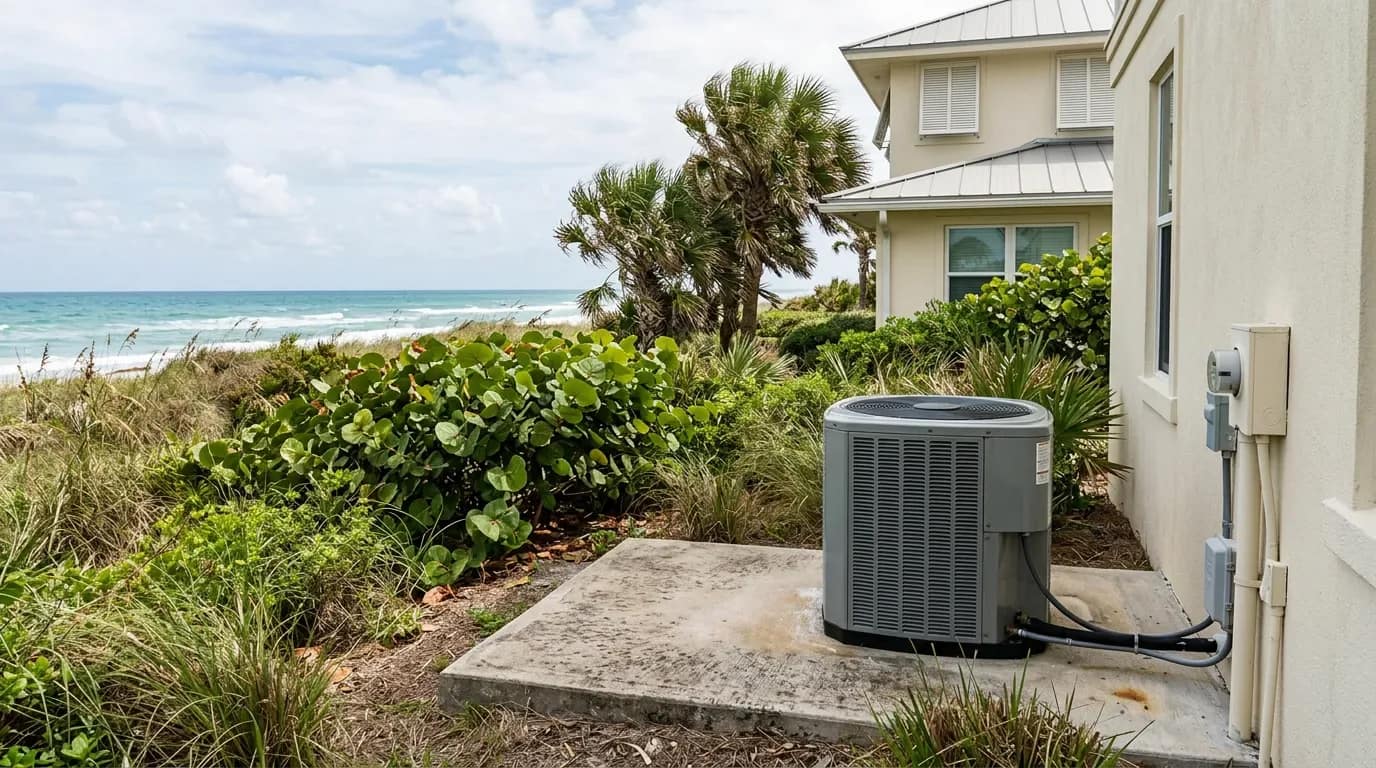
If you’re shopping for a new air conditioner on the Boca Raton coast, the brand question matters more here than almost anywhere else in the country. The short version is that Trane and Carrier tend to hold up longest against salt air, with Rheem and Ruud as strong mid-tier options for homes a mile or more inland. The longer answer depends on how close your property is to the Atlantic, how exposed the outdoor unit will be to onshore wind, and how carefully the installer handles the coastal environment during the job.
An air conditioner rated for twenty years of service in Ohio can rust out in five or six on this stretch of Florida. Salt spray drifts inland from the water every day, and the metal parts of an outdoor condenser have nowhere to hide from it.
What Is the Best AC Brand for Coastal Florida?
For coastal Florida homes exposed to salt air, Trane and Carrier are the two brands most often cited by installers for long service life. Both manufacturers offer models built for oceanside exposure with epoxy-coated coils and composite base pans that slow saltwater corrosion. Rheem and Ruud round out the top of the list as value picks, with cabinet protection that outlasts most entry-level equipment.
Which of the three is right for you depends less on marketing claims and more on where your home is located, how the outdoor unit will be positioned, and how much you plan to spend across the full life of the system rather than at the point-of-sale price.
How Far Are You From the Atlantic?
Distance from the ocean is the first filter on brand selection. Slide to your home’s rough distance from the water.
Within one mile of the water
Exposure is severe. Trane or the Carrier coastal series is the sensible choice — both build for oceanside exposure with coated coils and protective base pans.
Does Salt Air Ruin Air Conditioners?
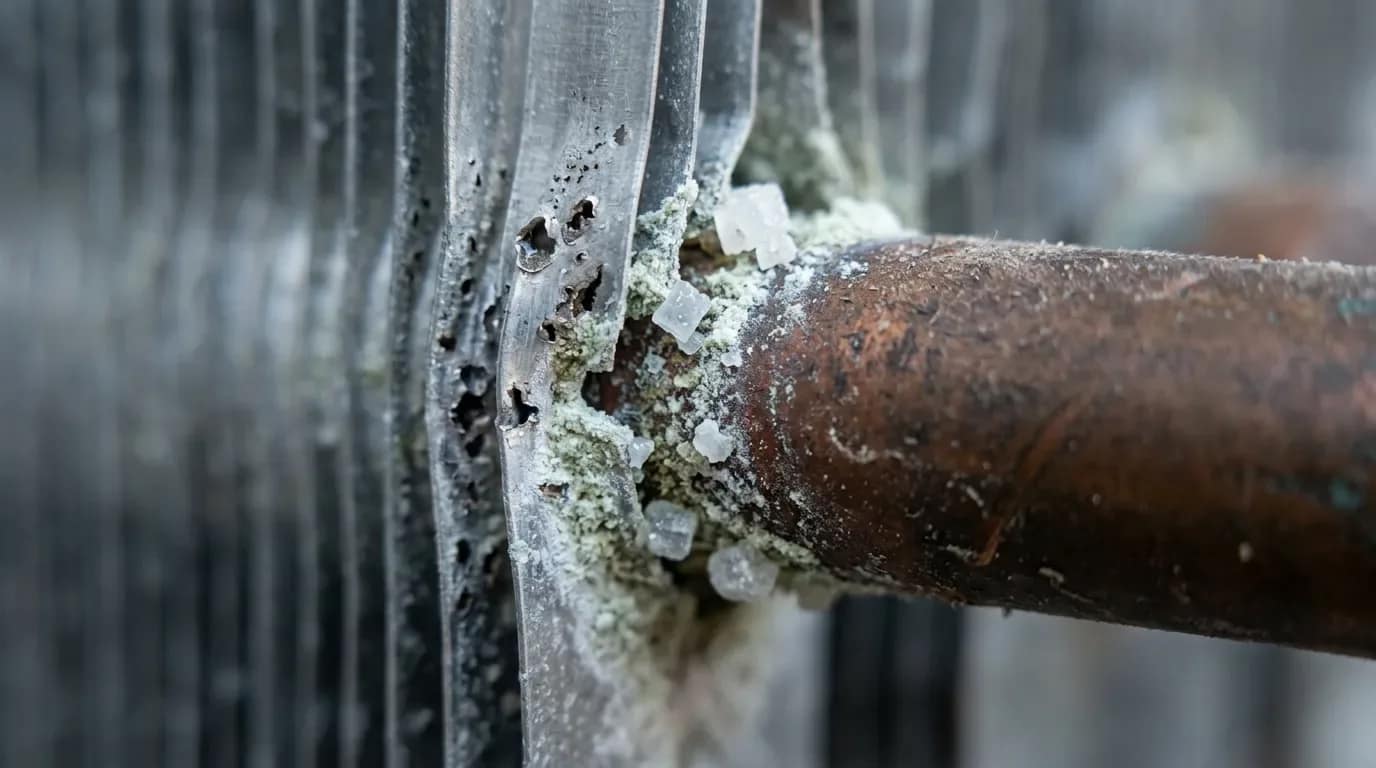
Yes, salt air shortens the working life of most air conditioners installed within a few miles of the coast. In the Boca Raton coastal environment, ocean breezes carry microscopic salt particles inland, and those particles settle on the copper tubes and aluminum fins of the condenser coil. Once they land, humidity turns them into a chemical mix that eats through metal at a rate no inland system was built to survive.
The mechanism has a name. Galvanic corrosion happens when two different metals meet in a moist, salty environment. Copper and aluminum, the classic coil pairing, react against each other. Add salt as an electrolyte and the process accelerates. A system tested only in dry Midwest conditions can carry the same efficiency rating as a coastal model, but it will not hold up the same way after a summer of onshore wind in Palm Beach County.
Why Boca Raton Is Harder on AC Equipment Than the Rest of Florida
Almost every home in Boca Raton falls within the corrosion zone because the city runs along the Atlantic for its full length. Salt exposure grades by distance from the shoreline. Within one mile of the water, exposure is severe. From one to five miles inland it stays moderate but constant, and even homes further west catch salt during hurricane season when storm winds push marine air across the region.
Humidity magnifies the damage. Boca averages high seventies to low nineties in relative humidity year-round, so salt particles rarely dry out on the equipment. They stay damp, keep reacting, and keep degrading metal at the microscopic level long before the system shows any outward sign of trouble.
Top AC Brands Built for Salt Air
The three brands most consistently installed on coastal South Florida homes are Trane, Carrier, and Rheem or Ruud. Each takes a different approach to fighting corrosion, and each fits a different price point.
Trane
Trane’s outdoor units use an all-aluminum Spine Fin coil rather than the traditional copper-tube-with-aluminum-fin build. Because the coil is a single metal, galvanic corrosion between copper and aluminum is off the table entirely.
- All-aluminum Spine Fin coil
- WeatherGuard enclosed cabinet
- Independent lab-tested salt claims
Trane systems cost more upfront. On the Boca Raton coast, that premium tends to pay back through longer equipment life and fewer refrigerant-leak service calls in years seven through twelve, which is where standard systems typically start to fail near the water.
Carrier
Carrier updated its coastal product line in 2023 with welded aluminum coils and zinc cladding on the base pan. That combination adds a second sacrificial barrier against salt, so corrosion has to eat through the zinc layer before it can reach structural metal.
- Welded aluminum coils
- Zinc-clad base pan
- Heat shrink on every brazed joint
The Performance Series runs up to 18.0 SEER2 with two-stage cooling, and the Comfort Series offers single-stage at up to 16.5 SEER2. Both use the WeatherArmor Ultra cabinet, which shields internal parts from direct salt spray and storm-driven debris.
Rheem & Ruud
Built by the same parent company, these are the mid-market answer for homeowners who want coastal-appropriate equipment without paying premium-brand pricing. Their outdoor cabinets use galvanized steel with a powder-coat finish that holds up well against salt.
- Powder-coated galvanized cabinet
- Coated coils for 1+ mile inland
- May need an add-on coating package
The tradeoff is straightforward. They do not carry the same coil-technology reputation as Trane, and warranty coverage on coastal installations sometimes requires an add-on coating package. For a home two or three miles inland, that is often a reasonable compromise.
Trane vs Carrier Florida: Which One Fits Your Home?
The Trane vs Carrier Florida comparison usually comes down to two factors. Trane’s Spine Fin coil is a fundamentally different construction that removes one corrosion pathway entirely. Carrier’s coastal series takes a more layered approach with welded aluminum, zinc cladding, and heat-shrunk brazed joints. Both approaches have strong field records in South Florida, so the deciding factors tend to be installer familiarity and warranty terms rather than raw engineering.
For beachfront properties and homes within one mile of the water, either brand is a defensible choice. For homes further inland, the Carrier coastal series can sometimes be more equipment than the environment requires, and a well-installed Rheem system reaches similar longevity for less money.
Coastal-Ready Models Worth Knowing
The specific model within a brand matters as much as the brand name itself. Coastal features are not standard across every unit a manufacturer sells, so the table below lists the model lines that carry coastal engineering as part of the base build.
| Brand | Coastal Model Lines | Key Coastal Feature | Typical Use Case |
|---|---|---|---|
| Trane | XV20i, XL18i, XR16 | All-aluminum Spine Fin coil, WeatherGuard cabinet | Homes within one mile of the Atlantic |
| Carrier | 24VNA6 Infinity, 24APB7 Performance, 24ACC6 Comfort | Welded aluminum coils, zinc base pan, heat-shrunk brazed joints | Beachfront and near-beach homes |
| Rheem | RA20 Prestige, RA17, RA16 | Powder-coated galvanized cabinet, coated coils | Homes one to five miles inland |
| Ruud | UA20 Ultra, UA17, UA16 | Same construction as Rheem counterparts | Homes one to five miles inland |
| Lennox | Signature Series XC25, XC21 | Quantum coil coating, heavy-gauge aluminum | Homes two to five miles inland |
Lennox does not market a dedicated coastal series the way Carrier does, but its Quantum coil coating and heavier-gauge construction handle moderate salt exposure well. Goodman and other entry-level brands can be installed on the coast, though the cabinet and coil construction usually is not built for the environment, and any price advantage disappears once you factor in a replacement cycle that may run five to seven years instead of ten to fifteen.
Installation Matters as Much as the Brand
Even the strongest coastal-rated system fails early if the install is done badly. Brazing done without a nitrogen purge leaves oxide flakes inside the refrigerant lines, and those flakes accelerate internal corrosion from the inside out. Uncoated field joints become the weakest link. Placing the condenser directly in the path of prevailing east winds, with no windbreak, guarantees more salt exposure than any manufacturer designed its equipment to handle.
The details that decide year seven
Anyone quoting a coastal Boca job should be able to walk you through their premium equipment installation process step by step, including how they handle brazing, coatings, and unit placement.
Condos, Rooftops, and Other Coastal Building Types
Beachfront and near-beach condos in Boca Raton bring a different set of constraints than single-family homes. Balcony placement limits airflow around outdoor equipment, association rules restrict where equipment can be installed, and salt exposure is often worse on higher floors because the wind carries salt further up than most people expect.
For condo owners choosing between central and ductless setups, the tradeoffs covered in solutions for beachfront condos in this market are worth reading through before locking in a brand. Larger commercial buildings, and some estate-scale single-family properties with mechanical space overhead, use packaged HVAC systems designed for rooftop installation, where salt exposure runs even more direct than at ground level.
Coastal AC Maintenance in Boca Raton
Even the strongest coastal-engineered AC needs regular attention to reach its full service life.
Rinsing the outdoor coil with fresh water every four to six weeks removes salt buildup before it starts to react with the metal. Homeowners can do this themselves with a garden hose at gentle pressure. Pressure washers should stay out of it, since the force will bend fins and cause more damage than the rinse prevents.
Service visits should happen twice a year in Boca rather than once. Coastal-focused work catches early pitting on coil surfaces, checks refrigerant lines for the small pinhole leaks salt tends to create at brazed joints, and refreshes anti-corrosion coatings before they wear off. Scheduled attention aimed at protecting equipment from corrosion is what separates a coastal system that lasts twelve to fifteen years from one that gives out in six.
Picking the Right AC Brand for Your Boca Raton Home
Distance from the ocean is the first filter. If your home is within a mile of the water, Trane or the Carrier coastal series is the sensible choice. Between one and five miles, Rheem and Ruud become reasonable, and Lennox is worth quoting alongside them. Past five miles inland from the Atlantic, the calculus starts to look more like standard South Florida HVAC, though salt exposure never fully disappears in Palm Beach County.
How long you plan to keep the home is the second filter. A ten- or fifteen-year horizon makes premium brands pay off through avoided replacement costs, and a shorter horizon leaves room for value-tier equipment paired with strong maintenance habits. Either way, the priority for anyone shopping the Boca Raton coast is finding an installer who understands what salt actually does to the system and builds the job around that.
Find an Installer Who Builds for Salt
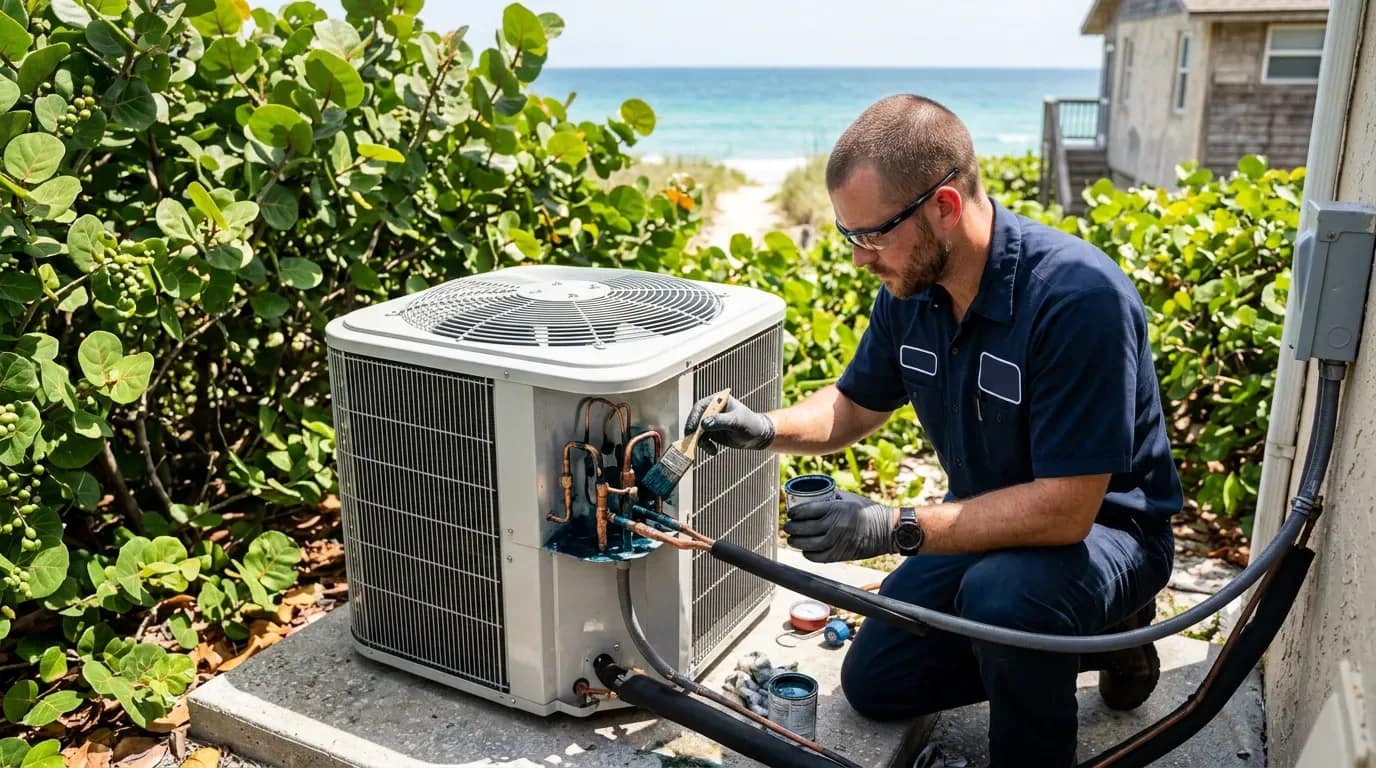
Pro Comfort AC installs coastal-rated equipment across Boca Raton — nitrogen-purged brazing, anti-corrosion treatment on exposed joints, and unit placement that shields the condenser from onshore wind.
Frequently Asked Questions
Trane and Carrier are the two brands most often cited by installers for long service life in salt air. Both offer models built for oceanside exposure with epoxy-coated coils and composite base pans. Rheem and Ruud round out the list as value picks for homes a mile or more inland.
Yes. Ocean breezes carry microscopic salt particles that settle on the copper tubes and aluminum fins of the condenser coil, and humidity turns them into a chemical mix that eats through metal. The process is called galvanic corrosion — copper and aluminum react against each other, and salt acts as the electrolyte that accelerates it.
Either is defensible within one mile of the water. Trane’s all-aluminum Spine Fin coil removes the copper-aluminum corrosion pathway entirely. Carrier’s coastal series layers welded aluminum, zinc cladding, and heat-shrunk brazed joints. The deciding factors tend to be installer familiarity and warranty terms rather than raw engineering.
Every four to six weeks with fresh water at gentle pressure from a garden hose. That removes salt buildup before it starts reacting with the metal. Keep pressure washers away — the force bends fins and causes more damage than the rinse prevents. Professional service should happen twice a year rather than once.