If your Boca Raton condo AC is not cooling, the first question is whether the problem is inside your unit or somewhere in the building’s shared HVAC system.
One warm condo while neighboring units are cooling normally usually points toward an in-unit problem. If several condos lose cooling around the same time, especially after building maintenance or a management notice, the shared water loop, pump, or cooling tower may be involved.
That pattern is a useful starting point, but it is not a diagnosis. Here is how to narrow down who to contact and what information to gather before anyone starts troubleshooting.
Before calling multiple contractors or assuming the building is responsible, look at what is happening around you.
If nearby units are cooling normally, start with an in-unit AC diagnostic.
Contact building management and ask whether there is a known problem with the shared loop, pumps, cooling tower, or other common equipment.
Pass that information to your technician. It can help determine whether the problem is connected to the common system or something inside your condo.
If you see smoke, smell burning, notice an electrical problem, or have fast-moving water near the equipment, stop operating the system and follow your building’s emergency procedure.
When several condo units stop cooling at roughly the same time, something shared by the building becomes more likely. When only one condo is affected, the problem is more often inside that unit. Tap a card to reveal what it may point to.
Shared loop, pump, cooling tower, or building control issue
Thermostat, airflow, drain, controls, refrigerant, or in-unit equipment
Common-system conditions may be involved
Intermittent unit or building-side condition
Heat-transfer or cooling-capacity problem
These are clues, not proof. A shared-system problem can affect only part of a building, while an individual unit can fail at the same time neighboring condos happen to be having problems.
Yes. In Boca Raton condos with water-source heat pumps, the equipment inside your unit relies on water circulating through a shared building loop.
During cooling, your heat pump removes heat from the condo and transfers it into that water. The building then uses shared equipment, such as pumps and a cooling tower or fluid cooler, to release the heat.
If the water gets too warm, flow drops, a pump stops working, or the cooling tower cannot keep up, your heat pump may struggle or shut down even though the equipment inside your condo is still running.
This connection between the condo equipment and the building loop is an important part of how water-source heat pumps work in Boca Raton condos. A technician may need information from both sides before the cause becomes clear.
The equipment inside the condo is still a heat pump, so normal heat pump service and repair may address unit-side problems even when the building manages the shared loop.
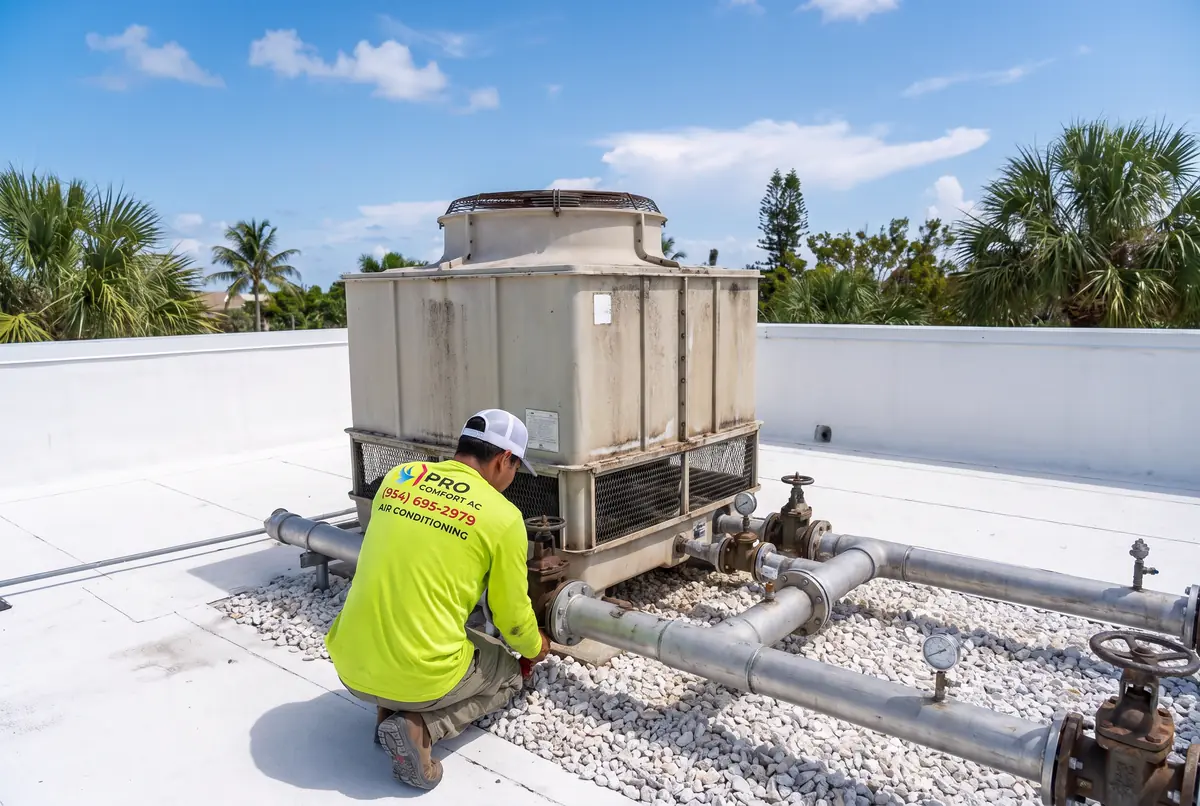
Not every condo uses a cooling tower. Boca Raton buildings can have several different HVAC setups, and knowing which one you have changes where troubleshooting begins.
The heat pump is usually inside the condo, while water circulates through a building-wide loop connected to shared pumps and heat-rejection equipment.
A cooling problem can therefore start either inside your condo or somewhere in the common system.
Some condos have dedicated equipment on the roof rather than a water-source heat pump inside the unit.
These systems do not depend on a shared water loop, so a cooling tower problem would not explain the loss of cooling. Diagnosing them instead requires access to the rooftop HVAC unit serving the condo.
Some lower-rise condos and townhome-style communities have an indoor air handler paired with an outdoor condenser.
These systems generally operate independently. If air is moving poorly, water is forming around the indoor equipment, or the blower is not working correctly, the air handler may be part of the problem.
If you are unsure which setup your building uses, property management or a technician providing HVAC service in Boca Raton can usually identify it quickly.
You do not need to troubleshoot mechanical equipment yourself. A few safe observations can give your technician or property manager much better information.
Avoid opening equipment panels, touching water-loop valves, accessing the roof, or repeatedly resetting breakers.
If only your condo is affected and there is no building notice, an AC repair diagnostic is usually the most direct next step.
It depends on whether the problem appears limited to your condo or involves the building.
| Situation | Best first contact | What to tell them |
|---|---|---|
| Several units are warm or management issued a notice | Property manager or building engineer | When cooling stopped, affected area, thermostat fault |
| Only your condo is affected | Unit-side HVAC technician | Temperature, fan behavior, fault code, recent service |
| Water is coming from common piping | Building emergency contact | Location, amount of water, photos |
| You are away from Boca Raton | Manager, caretaker, or authorized HVAC provider | Access instructions and written authorization |
If your condo appears to be the only one affected, the technician can check the unit while management confirms that the building loop is operating normally.
If several condos are affected, management will usually need to coordinate the building-side response before individual repairs make sense.
There is no reliable rule that says “one unit means the owner” and “several units mean the association.”
Responsibility depends on the condo declaration, building rules, service contracts, and where the failed component is located.
In many water-loop buildings, the association manages common equipment such as circulating pumps and cooling towers, while the owner is responsible for equipment inside the condo. Other buildings divide responsibility differently.
A problem involving the cooling tower, common pumps, or other equipment serving multiple units may require a contractor experienced with commercial and multi-unit HVAC systems, coordinated through the association rather than an individual resident.
Before authorizing major work, ask management where the building’s responsibility ends and the owner’s begins.
When only one condo is not cooling, the technician usually starts with the equipment inside the unit.
That can include checking:
If the in-unit equipment appears functional but the water-source heat pump is not getting the water flow or temperature it needs, the technician may need the building manager to confirm what is happening with the shared loop.
That distinction matters because replacing a part inside your condo will not solve a cooling problem caused by the building system.
Water around a condo HVAC closet can come from more than one source.
Condensate from the AC usually appears around the drain line, drain pan, or indoor unit while the system is cooling. A clogged drain or another air handler water problem can cause water to collect even when the building loop is working normally.
Building-loop water is more likely to appear around supply and return piping, fittings, valves, or connections serving a water-source heat pump.
Do not rely on the water’s color or smell to identify it. If the source is unclear, photograph where the water is appearing and contact the appropriate building responder or HVAC technician.
Fast-moving water, electrical exposure, smoke, or a burning smell should be treated as an emergency.
A clear report makes it easier for management to see whether your complaint is isolated or part of a larger pattern.
Include:
Building and unit number
Date and time the problem started
Thermostat setting and indoor temperature
Any fault code or message
Whether the fan is running
Whether neighboring units are affected
Photos of visible water or equipment messages
Any recent building HVAC notices
Recent service history, if relevant
Your availability or access instructions
Keep a copy. Intermittent problems can disappear before a technician arrives, and a simple record can help show what was happening when the system failed.
If the same issue keeps returning, those notes can also be useful during future HVAC maintenance visits because the technician has a clearer history to work from.
Once a shared-system problem has been corrected, cooling should be checked inside the affected condos too.
Your heat pump may still have a fault, or your condo could have a separate problem that happened around the same time as the building issue.
If management confirms that the shared loop is operating normally but your condo still does not cool, the next step is an in-unit diagnostic rather than repeated thermostat or breaker resets.
For an older system with recurring failures, the repair history may eventually raise a different question: whether another repair is worthwhile or whether replacing the condo AC system makes more sense.
Most condo cooling problems fall into one of three situations.
Start with an in-unit diagnostic and ask management whether the shared system is operating normally.
Contact building management first. A shared pump, water loop, cooling tower, or other common component may be involved.
Follow the building’s emergency procedure and do not attempt to access or reset shared equipment.
You do not need to diagnose the entire building yourself. Identify whether the problem appears isolated or shared, document what you are seeing, and start with the side of the system that best matches those clues.
Every home cools differently based on size, layout, and insulation. During the consultation, we recommend energy-efficient systems from all major brands that fit your needs and budget. We handle everything from equipment selection to final testing, balancing upfront AC installation cost with long-term energy savings.
Central air conditioning is the most popular choice for South Florida homes. These systems use your existing ductwork to deliver consistent temperature throughout your house. We install units that balance powerful cooling with reasonable energy bills.
Ductless mini-splits let you control each room's temperature separately. Each unit works on its own, so everyone can set their preferred setting. They work well for room additions, converted garages, or homes without ductwork.
Upgrade your new system with a smart thermostat. We install and program the latest Wi-Fi thermostats from Nest, ecobee, and more, giving you total control over your home's comfort and energy use.
When upgrading your AC, your duct system matters just as much as the unit itself. Leaky or poorly insulated ducts waste cooling and drive up costs. Our duct services identify and fix problem areas to maximize efficiency.
Our HVAC technicians install, repair, and service all major brands. We stock parts for most manufacturers and can order components when needed.


Pro Comfort AC has built our reputation on honest service and quality workmanship. When you need reliable AC Installation in Deerfield Beach, FL, we do things the right way.

Our installers are state-certified and EPA-credentialed. They follow manufacturer specs and Florida building codes on every job.

You'll receive a detailed estimate that breaks down equipment costs, labor, and any additional work required. No hidden fees appear on your final invoice.

We offer financing plans that make it easier to afford the air conditioner replacement your home needs. Ask our team about available payment options during your consultation.

We stand behind our work. Every new AC unit installation includes a full year of warranty coverage on all installation labor, giving you confidence in your investment.
Quality brands we trust