Water around a ceiling vent does not always mean you have a roof leak. In Boca Raton, high humidity can cause cold AC ducts, ceiling boots, or registers to collect condensation, especially when insulation or air sealing has been damaged.
Timing is often the first clue. Moisture that appears while the AC is running may point to sweating ductwork. Water that shows up during or after rain may be coming through the roof. But water can travel along insulation, framing, and ductwork, so finding the source matters before repairing the ceiling or duct.
If water is reaching the ceiling, protect the area first and pay attention to when the moisture appears.
You do not necessarily need to shut off the entire AC system. That depends on where the water is coming from, how severe it is, and whether continuing to run the system could cause more damage.
Duct condensation and roof leaks can look surprisingly similar. The pattern, timing, and location of the moisture can help narrow down the cause.
| Clue | Duct condensation may be more likely | Roof leak may be more likely |
|---|---|---|
| Timing | Appears during long AC cycles or very humid weather | Appears during or after rain |
| Location | Near a vent, duct run, boot, or cold metal surface | Near roof penetrations, flashing, or a path from the roof deck |
| Insulation | Wet around damaged duct wrap or a poorly sealed boot | Wet from above or across the roof structure |
| Moisture pattern | Beads or dampness on a cold surface | Drips, stains, or spreading moisture |
| Testing | Duct surface is below the surrounding dew point | Moisture can be traced toward the roof |
These are clues, not a diagnosis. A roof leak can travel before it becomes visible, and duct condensation can soak insulation before it reaches the drywall.
If the pattern is mixed, both an HVAC technician and a roofer may need to inspect the area.
AC ducts sweat when a cold duct surface comes into contact with warm, humid air.
It is the same reason moisture forms on the outside of a cold glass. When the surface of the duct becomes colder than the dew point of the surrounding air, water vapor turns into condensation.
That can happen quickly in a hot Florida attic. Duct insulation and its outer vapor barrier are designed to keep humid attic air away from the cold duct surface. Problems begin when that protection is damaged or when humid air reaches exposed metal around a ceiling vent.
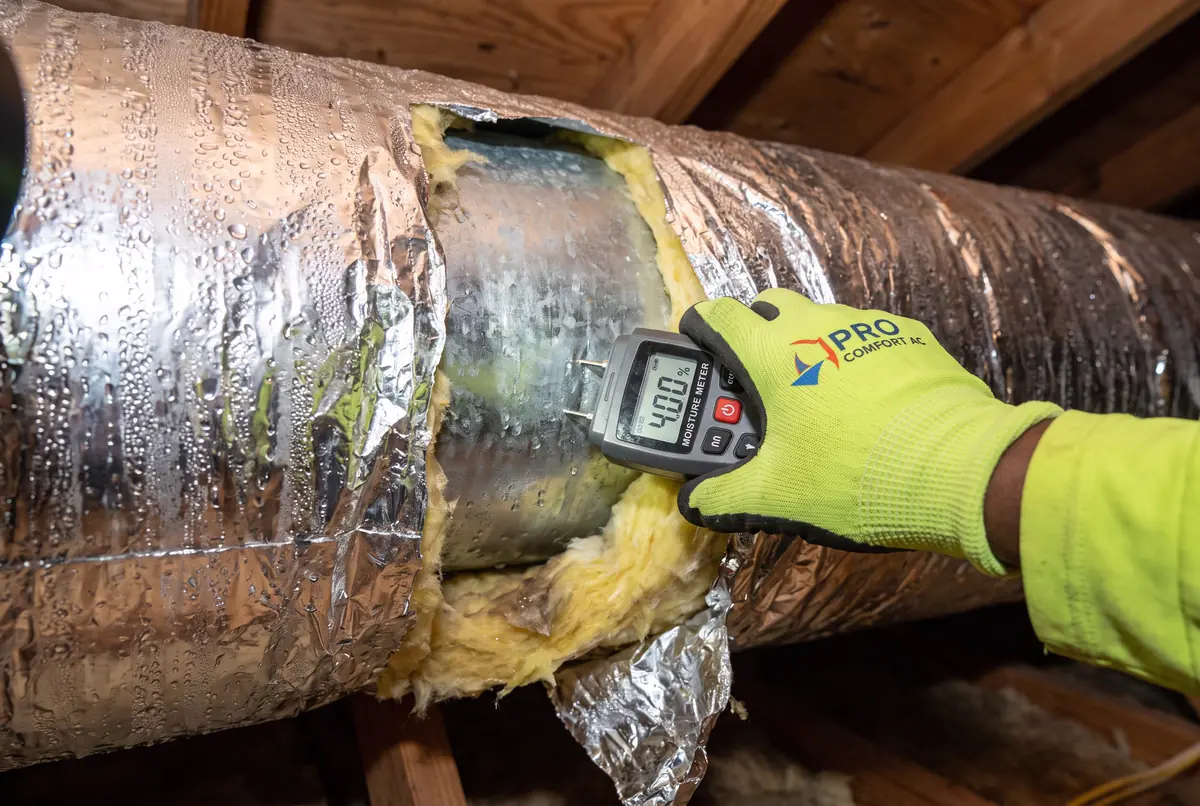
Condensation on AC ducts in a Florida attic is usually a sign that one or more of these conditions needs attention, rather than simply a result of hot weather.
The right repair depends on where humid air is reaching the cold surface and why.
| Problem | What may be happening | Typical repair direction |
|---|---|---|
| Damaged duct insulation | Humid attic air reaches the cold duct | Repair or replace damaged insulation |
| Open duct seam | Conditioned air leaks through a connection | Seal the joint and restore insulation |
| Air leak around ceiling duct boot | Hot attic air reaches cold metal | Air-seal and insulate the boot |
| Restricted airflow | Duct or coil temperatures become unusually low | Find and correct the airflow problem |
| Return leak | Humid attic air gets pulled into the system | Seal the return-side leakage |
| High attic moisture | Ductwork is surrounded by unusually humid air | Address the HVAC or building-envelope cause |
This is why AC duct repair in Boca Raton should start with the cause rather than simply adding more insulation. Covering an active air leak can hide the problem without stopping the condensation.
When insulation or the vapor barrier has deteriorated, repairing damaged ductwork and air leaks may involve resealing connections, restoring insulation, or replacing sections that are too damaged to repair.
Restricted airflow can contribute as well. Even something as simple as using a filter that is too restrictive for the system can affect airflow, which is why choosing the right AC filter and MERV rating matters beyond indoor air quality alone.
Yes. The area where a duct connects to a ceiling register is a common place for condensation to develop.
If there is a gap around the duct boot or drywall opening, warm attic air can reach the cold metal. Water may then collect around the boot or register and eventually soak into the surrounding ceiling.
If moisture is traveling through the duct from the HVAC equipment, an air handler leaking water could point to a clogged condensate drain, drain pan problem, or another issue inside the system. Those problems require a different repair than condensation around a ceiling boot.
Yes. Where the ducts are located changes both the risk of condensation and what should be inspected.
Flexible or insulated metal ducts running through an attic are surrounded by hot, humid air. A tear in the insulation, an open seam, or exposed metal around a ceiling boot can give that humid air direct access to a very cold surface.
The result may be sweating ductwork even when the AC itself is cooling normally.
Condos may have shorter interior duct runs connected to a fan coil or heat pump rather than long attic ducts.
In these buildings, water around a ceiling vent may come from duct insulation, the HVAC cabinet, drainage, or another concealed source. Because there may be no attic directly above the wet area, tracing the source can be different from diagnosing the same stain in a single-family home.
Looking at the water stain alone is rarely enough. A useful inspection compares the moisture pattern with temperature, humidity, airflow, and the condition of the ductwork.
Depending on the system and access, a technician may check:
Indoor and attic temperature
Relative humidity
Dew point
Duct and register surface temperatures
Moisture levels in drywall and insulation
Duct insulation and vapor-barrier condition
Accessible seams and ceiling boots
Airflow and pressure problems
AC runtime patterns
Whether the moisture appears during rainfall
These measurements help determine whether the duct is actually sweating or whether the water is coming from somewhere else.
Not necessarily.
A small insulation tear, leaking seam, or poorly insulated ceiling boot can often be repaired without replacing the entire duct system.
Replacement becomes more likely when ductwork is badly damaged, crushed, repeatedly saturated, or has widespread insulation failure.
A reasonable repair process usually looks like this:
Duct cleaning will not fix sweating caused by damaged insulation, air leakage, or condensation conditions. The condition of the ducts themselves matters more when moisture is the problem.
Yes. Repeated condensation can stain drywall, damage paint and texture, soak insulation, warp trim, and corrode metal components.
Long-term moisture can also create conditions where microbial growth becomes possible on wet building materials.
That is why a recurring stain should be investigated rather than repeatedly dried or painted over. If a large area has stayed wet for an extended period, drying or remediation may also require a specialist outside the HVAC trade.
Sweating ducts can sometimes be one sign of a larger humidity problem.
If your home feels clammy even after it reaches the thermostat setting, the AC may not be removing enough moisture. In some homes, an oversized AC can leave the house feeling humid because it cools the space quickly and shuts off before running long enough to dehumidify effectively.
How the system runs can provide another clue. If you're seeing moisture along with very short or unusually long cooling cycles, normal AC runtime in Boca Raton can help you recognize when the operating pattern itself may need attention.
Once the source has been repaired, a few basic steps can lower the chance of another wet ceiling.
Routine HVAC maintenance can also catch drainage, airflow, coil, and duct problems before they become visible water damage.
Seasonal homes need a little more attention because a small moisture problem can go unnoticed for weeks. If the property will be empty through part of the South Florida summer, setting the AC up properly while you're away can reduce the risk of returning to humidity problems or a wet ceiling.
If moisture appears mainly while the AC is running and follows a cold duct, register, or area of damaged insulation, duct condensation is more likely.
If the water appears during or after rain and traces back toward a roof penetration or roof structure, a roof leak becomes more likely.
If both patterns are present, do not assume there is only one source. A roof problem and HVAC condensation can happen at the same time.
When the source is still unclear, an HVAC inspection in Boca Raton can rule out duct, drainage, airflow, and equipment-related causes before the ceiling or insulation is repaired. Finding the source first is what keeps the same stain from coming back.
Every home cools differently based on size, layout, and insulation. During the consultation, we recommend energy-efficient systems from all major brands that fit your needs and budget. We handle everything from equipment selection to final testing, balancing upfront AC installation cost with long-term energy savings.
Central air conditioning is the most popular choice for South Florida homes. These systems use your existing ductwork to deliver consistent temperature throughout your house. We install units that balance powerful cooling with reasonable energy bills.
Ductless mini-splits let you control each room's temperature separately. Each unit works on its own, so everyone can set their preferred setting. They work well for room additions, converted garages, or homes without ductwork.

Upgrade your new system with a smart thermostat. We install and program the latest Wi-Fi thermostats from Nest, ecobee, and more, giving you total control over your home's comfort and energy use.
When upgrading your AC, your duct system matters just as much as the unit itself. Leaky or poorly insulated ducts waste cooling and drive up costs. Our duct services identify and fix problem areas to maximize efficiency.
Our HVAC technicians install, repair, and service all major brands. We stock parts for most manufacturers and can order components when needed.


Pro Comfort AC has built our reputation on honest service and quality workmanship. When you need reliable AC Installation in Deerfield Beach, FL, we do things the right way.

Our installers are state-certified and EPA-credentialed. They follow manufacturer specs and Florida building codes on every job.

You'll receive a detailed estimate that breaks down equipment costs, labor, and any additional work required. No hidden fees appear on your final invoice.

We offer financing plans that make it easier to afford the air conditioner replacement your home needs. Ask our team about available payment options during your consultation.

We stand behind our work. Every new AC unit installation includes a full year of warranty coverage on all installation labor, giving you confidence in your investment.
Quality brands we trust