

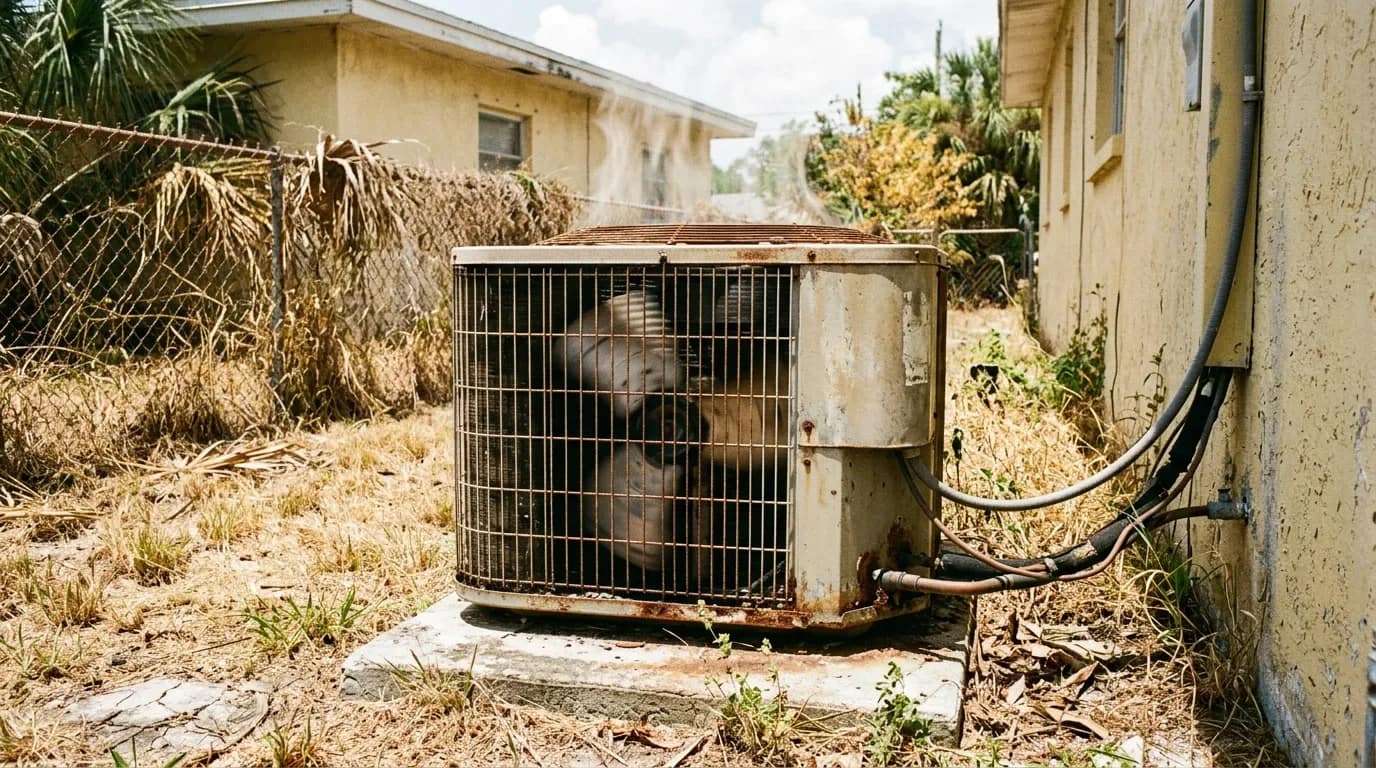
Signs Your AC Needs Full Replacement (Not Just Repair)
Age past 10 years, R-410A recharges above $500, and rising FPL bills point to replacement over repair. Here’s the 5,000 rule and 5 other signals to watch for.
Your AC is limping through another Boca Raton summer and you’re staring down another repair bill. Some homeowners are ready to spend the money, hoping the fix buys them another year. Others feel like they’re throwing cash at a system that keeps letting them down. This guide walks through the clearest signs AC needs replacement over another repair, and gives you a framework for making the call before the next breakdown makes it for you.
How Do I Know It’s Time to Replace My AC?
Replacement makes more financial sense than repair once the unit passes ten years of age, runs on phased-out refrigerant, breaks down repeatedly, or hits the $5,000 rule where the age of the unit multiplied by the repair estimate crosses five thousand dollars. Rising FPL bills with no change in your usage and an inability to hold indoor temperatures below 78 degrees on hot afternoons also point to terminal failure.
Not every issue calls for a new system. A capacitor swap on an eight-year-old unit with clean coils and a healthy compressor is worth the money. The signals in this guide describe a system whose core components are wearing out together, which is a different problem from a single part failing on an otherwise healthy machine.
The $5,000 Rule Calculator
Multiply the age of the AC in years by the cost of the proposed repair. If the number crosses $5,000, replacement is the smarter financial move.
Replace
A $600 fix on a ten-year-old system in South Florida typically buys you maybe another year of service before the next component fails.
How the Math Plays Out
The $5,000 rule is a simple diagnostic tool used across the HVAC industry to weigh a repair against a full replacement. Here’s how it plays out for a Boca Raton homeowner facing a typical repair estimate.
| AC Age | Repair Cost | Age × Cost | Recommendation |
|---|---|---|---|
| 5 years | $800 | $4,000 | Repair |
| 8 years | $700 | $5,600 | Consider replacement |
| 10 years | $600 | $6,000 | Replace |
| 12 years | $450 | $5,400 | Replace |
| 14 years | $400 | $5,600 | Replace |
The rule accounts for the fact that even a modest repair on an older unit rarely pays for itself. A $600 fix on a ten-year-old system in South Florida typically buys you maybe another year of service before the next component fails. Working through detailed repair comparisons for homes across Boca Raton can help you sanity-check any estimate against the age and service history of your unit.
Five Clear Signs Your AC Needs Replacement in South Florida
The five patterns below are the ones technicians see repeatedly on service calls across Palm Beach County. Any one of them alone might not force your hand. Two or three showing up together usually means the system is approaching the end of its useful life.
Age Over Ten Years
Air conditioners in South Florida run harder and longer than units almost anywhere else in the country. National averages put a residential AC at 15 to 20 years, but along the coast the realistic range is 10 to 12 years, with salt air east of Federal Highway shaving another year or two off that.
Aging systems also carry hidden compatibility problems. Manufacturers stop producing replacement boards, motors, and coils for older models, so a fix that should cost a few hundred dollars can balloon once the technician has to source obsolete parts.
The Refrigerant Trap
R-22 systems, generally installed before 2010, cannot be recharged with anything close to affordable refrigerant since the EPA production ban took full effect years ago. R-410A recharges, once a routine $150 to $300 job, now run $300 to $600 as manufacturers wound down production ahead of the 2026 phase-out.
If a technician says the system is low on refrigerant, that almost always means it’s leaking somewhere. Paying to top off an old unit is money you’ll spend again in a season or two. Homeowners weighing this trade-off often bring the estimate to a professional AC repair team for a second opinion before signing off on an expensive recharge.
Compressor Noises
The compressor is the heart of the outdoor unit and the single most expensive part to replace. Grinding, screeching, banging, or a rhythmic clunking during startup are all signs of internal wear or a failing motor. Some people describe it as a dishwasher full of gravel, and once you hear it, it’s hard to unhear.
A compressor replacement on an eight-year-old system can run $1,800 to $3,500 installed. On a ten-plus-year-old unit, that money is almost always better spent on a complete system replacement that comes with a new warranty and modern efficiency ratings.
Blowing Warm Air
An AC blowing warm air during a Florida summer is a real safety concern, not simply an inconvenience. If the system runs all day but the thermostat won’t drop below 78 degrees, the underlying cause is usually a failing compressor, a serious refrigerant leak, or a condenser coil that can no longer transfer heat.
Short-cycling, where the AC turns on and off every few minutes without pulling the temperature down, points to the same story. Homes without functional cooling during a Boca Raton heat wave are dangerous for older adults, young children, and pets, which is why calling for emergency breakdown assistance is worth doing rather than waiting overnight.
FPL Bills Climbing
A steady climb in your FPL bill without any change in thermostat settings, occupancy, or the rate structure is a classic marker of a dying AC. As compressors weaken, refrigerant charges drop, and coils foul, the system has to run longer to hit the same setpoint, and your bill reflects that extra runtime.
Newer 16 to 18 SEER2 systems typically cut cooling costs by 30 to 40 percent compared to a ten-year-old 13 SEER unit. That savings alone can offset a good chunk of the financing payment on a new install, which changes how homeowners think about the upfront cost.
Is It Worth Fixing a 10 Year Old AC?
Fixing a 10 year old AC is worth it only if the repair is minor, roughly under $400, and the rest of the system is in solid shape. Beyond that threshold, the math almost always favors replacement, especially in South Florida where the coastal climate accelerates wear on every component.
A ten-year-old unit is already at or past the average lifespan for a Boca Raton home. Even a successful fix leaves you with an aging compressor, corroded fins, and dated efficiency ratings. Most homeowners who try to squeeze another season out of a decade-old system end up paying twice, once for the repair and again for the replacement six to eighteen months later.
How Do I Know If My AC Compressor Is Bad?
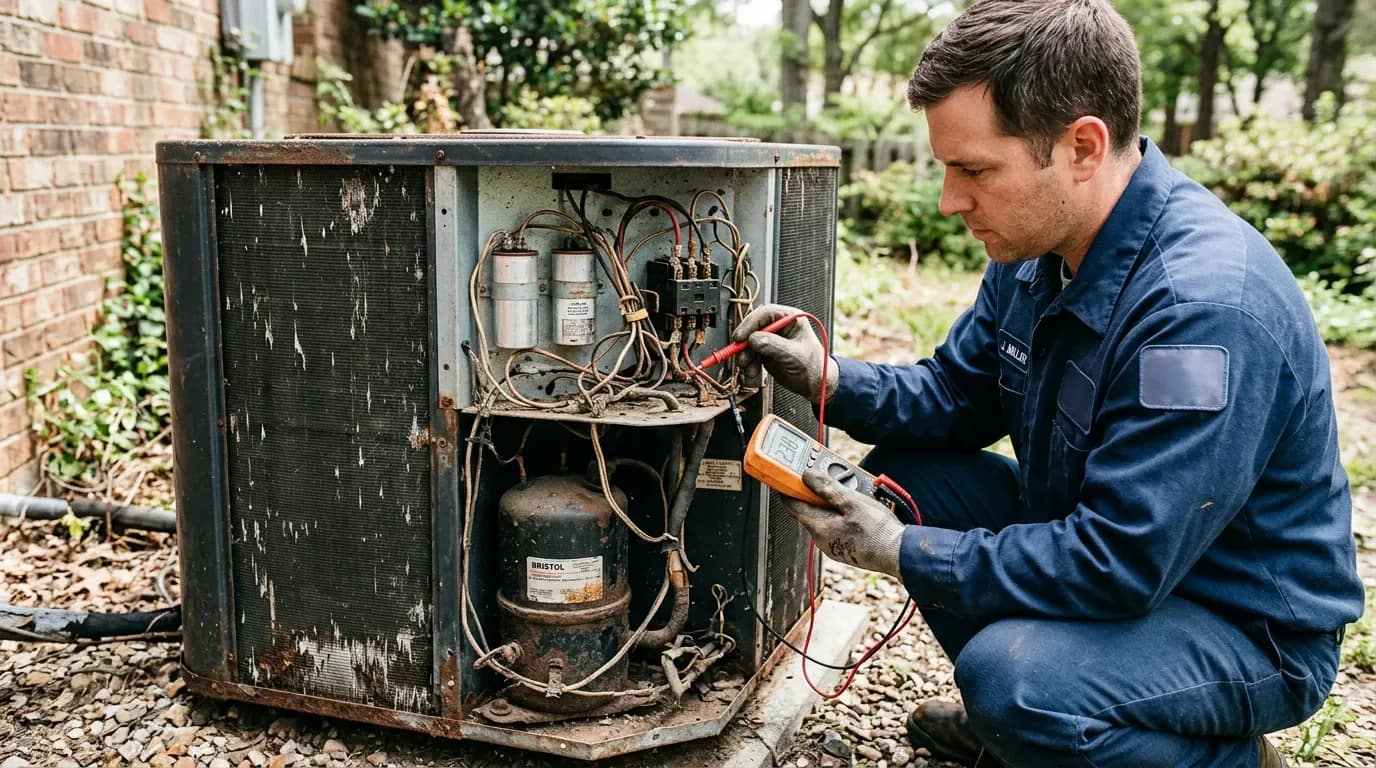
A failing compressor typically announces itself through a mix of noise, heat, and electrical symptoms. Common warning signs include hard starts, where the outdoor unit strains audibly before spinning up, tripped breakers whenever the system tries to run, unusually hot air coming from the outdoor fan, and warm air blowing from the vents while the outdoor unit is running.
Diagnosis is a job for a licensed HVAC technician with the right gauges and electrical testing equipment. A compressor swap is a large repair on any age of system, and on a unit past the eight-to-ten-year mark, it’s almost always the moment to price out a new system rather than throw money at the old one.
Modern AC Replacement Systems Worth Knowing About
Replacement conversations in 2026 involve three broad tiers of equipment, and knowing the difference helps you compare quotes with a clearer eye. Every reputable brand builds systems across all three tiers, so the choice usually comes down to how much humidity control and quiet operation you want, and what your monthly energy budget looks like.
One speed, lowest cost
They run at full power until the thermostat is satisfied, then shut off. Fine for smaller homes with good insulation, but they struggle with humidity control during the long South Florida cooling season because they don’t run long enough to pull moisture out of the air.
Rheem RA14AZ, Goodman GLXS3BA, Carrier Comfort 14
Low or high, better humidity
Low-stage operation, which handles most days in Boca Raton, produces longer, gentler cooling cycles and noticeably better dehumidification. Homeowners usually notice quieter operation and drier indoor air compared to a single-stage replacement.
Trane XR17, Carrier Performance 17, Lennox Elite EL17XC1
Continuous, driest air
Adjusts output continuously, often running at 30 to 40 percent capacity for long stretches. The compressor is almost always running quietly in the background, keeping indoor humidity below 55 percent and holding tighter temperature swings.
Carrier Infinity 26 Coastal, Trane XV20i, Lennox SL28XCV, Daikin Fit
Installation costs run $11,000 to $16,000 for a 3 to 4 ton variable-speed system, and salt-air coated coils on models like the Carrier Coastal line matter for homes east of Federal Highway.
Why Planned Replacement Beats a July Breakdown
An unplanned replacement during a Boca Raton heat wave is one of the more stressful decisions a homeowner can face. Supply gets thin, install slots book out for days, and rushed choices lead to oversized units, corners cut on the linesets, or brands the homeowner would never have picked with time to compare. Recognizing the signs early puts you in a very different negotiating position.
Planning ahead saves 10 to 20 percent
Homeowners who plan the replacement typically save 10 to 20 percent versus emergency pricing, get to compare three or four quotes at their own pace, and can pick equipment that fits their home, budget, and humidity goals.
For homeowners who want a considered conversation about timing, sizing, and coastal equipment options, the Boca Raton AC specialists can walk through the decision without any pressure to buy.
Run the Numbers Before the Next Breakdown
Pro Comfort AC will walk through the age, service history, and refrigerant type on your system and price out both paths — no pressure to buy, just a straight read on where the math lands.
Frequently Asked Questions
Multiply the age of the AC in years by the cost of the proposed repair. If the number crosses $5,000, replacement is the smarter financial move. It accounts for the fact that even a modest repair on an older unit rarely pays for itself — a $600 fix on a ten-year-old system typically buys maybe another year.
Only if the repair is minor, roughly under $400, and the rest of the system is in solid shape. Beyond that, the math almost always favors replacement. Most homeowners who try to squeeze another season out of a decade-old system end up paying twice — once for the repair and again for the replacement six to eighteen months later.
Watch for hard starts where the outdoor unit strains audibly before spinning up, tripped breakers whenever the system tries to run, unusually hot air from the outdoor fan, and warm air from the vents while the outdoor unit is running. Grinding, screeching, or rhythmic clunking during startup all point to internal wear.
Homeowners who plan typically save 10 to 20 percent versus emergency pricing. During a heat wave, supply gets thin and install slots book out for days, which leads to rushed choices — oversized units, corners cut on linesets, or brands you’d never have picked with time to compare.