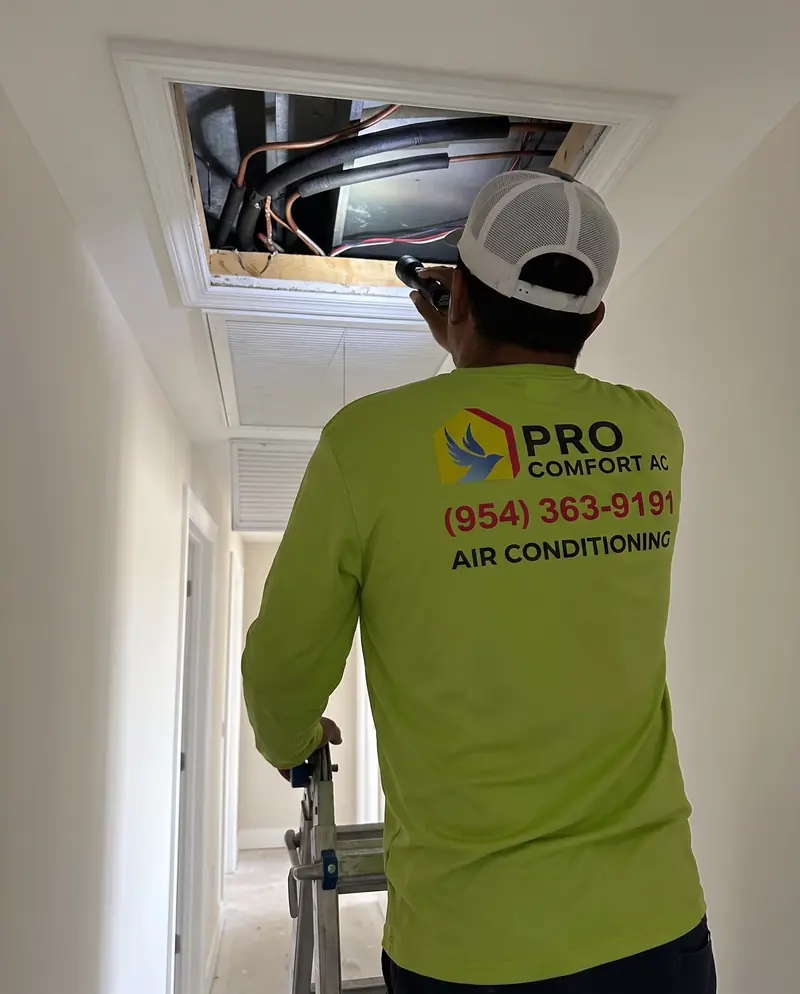
"It’s low on Freon" often comes with an offer to top the system off, but an AC that needs refrigerant again is losing it somewhere. A quote to find and fix the leak can look steep next to one more refill, though the two prices pay for very different jobs.
The cost of an AC refrigerant leak repair comes in two parts. Finding the leak starts with a diagnostic visit, about $75 to $150 nationally as of March 2026. Fixing the leak and recharging the system runs about $200 to $1,500 nationally as of January 2026, around $800 on average.
Depending on where the leak is and how big it is, the total can reach $1,200 to $3,000 or more nationally, as of June 2026. What you’re paying to fix is the leak, not the refrigerant.
Each part of the bill pays for different work, and the recharge is the one you pay for again every time an unrepaired leak empties the system. No reliable source reports these prices for Florida alone, so every range here is national.
| Part of the Bill | National Range and Date | What It Covers |
|---|---|---|
| Diagnostic visit | About $75 to $150, as of March 2026 | The visit and the diagnosis, and some companies apply it to the repair |
| Leak repair with recharge | $200 to $1,500, about $800 on average, as of January 2026 | Fixing the leak and refilling the refrigerant |
| A larger leak, or one in a harder spot | $1,200 to $3,000 or more, as of June 2026 | The bigger repair, the labor and the refrigerant |
| Recharge alone | $100 to $600, as of January 2026 | Refrigerant only, paid again each time the leak empties the system |
Two leak quotes can look far apart only because one leaves part of the job out, so check what each one includes. A price for refrigerant alone, with no repair, pays for the one part of the bill that keeps coming back.
With us, each service call is $125, and it’s credited toward your repair if you decide to move forward. Our state certification as an air conditioning contractor is license CAC1822561, and the state’s public license records list it as current and active.
A leak at a valve or a line joint is usually the smaller repair, while a leak in a coil can mean repairing or replacing the coil itself.
Where the Leak IsUsual PriceWhat the Fix Usually Involves
Leaks often turn up in the indoor coil, where household chemicals can corrode the copper. A leak there can mean replacing the coil, which comes with its own refrigerant rule, and what a new evaporator coil costs depends on the coil type and the system’s size.
If the leak turns out to be at a valve core on a service port, the bill looks more like what other common AC repairs cost than a coil job.
A refrigerant leak can be fixed, and the repair is easiest to justify when the leak has been found, it can be reached, and it’s the only problem the system has. Five quick questions sort out the rest, and if most of the answers are no, put a replacement quote next to the repair quote.
EPA’s 2026 rule, in effect since July 27, 2026, says the price of refrigerants such as R-410A "may rise as the phasedown continues." That’s the recharge part of the bill, so what’s happening to R-410A prices matters most while a leak stays unrepaired.
EPA also calls refrigerant cost "only one factor" in deciding between a repair and a new system. On an aging system with a leaking coil, moving to a new system belongs in the comparison.
A system that keeps needing refrigerant is losing it somewhere, and a refill without a repair leaks out the same way. You pay for the refrigerant, and then you pay for it again.
Carrier describes adding refrigerant to a leaking system as a temporary fix that can lead to compressor failure, and says manufacturers generally don’t recommend leak sealants because they can clog the expansion valve.
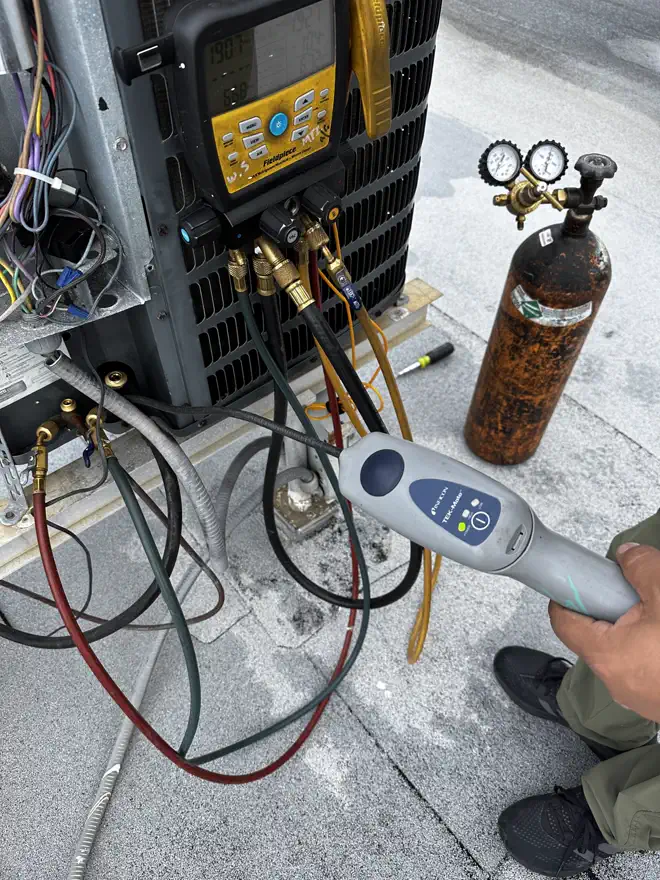
Booking a leak search and repair visit first means you pay for refrigerant once, after the leak is sealed. A leak search can use an electronic detector, UV dye or soap bubbles to find the exact spot.
No. EPA’s leak-repair rules have applied since January 1, 2026, to appliances holding 15 pounds or more of refrigerant, and EPA’s answer on leak repair rules, updated in November 2026, says home and light commercial air conditioners and heat pumps "are not included in the leak repair provisions."
So those rules don’t require a home system’s leak to be fixed before a top-off, whatever some online answers say. Topping off without a repair is a choice, and it’s one that costs you each time.
There’s no reliable answer, because it depends on how big the leak is. Each refill lasts only until the charge has leaked out again, and the next one costs about the same as the last. Needing refrigerant at all means the system is leaking, however long the gap between refills.
A refrigerant leak usually shows up in how the system cools before anyone sees the leak itself. Watch for these signs.
Weak cooling. The air from the vents feels warmer than it used to, and the house takes longer to cool down.
Ice on the indoor coil. Low refrigerant is one reason for an AC that freezes up, among other causes.
Hissing or bubbling. A hiss or a bubbling sound near the equipment can mean refrigerant is escaping.
Higher bills and stickier air. Your power bill climbs, and the house feels humid even with the AC running.
Water pooling around the indoor unit isn’t leaking refrigerant, and water dripping from the indoor unit has its own causes and fixes.
If you think the system is leaking refrigerant, a few practical steps come first.
EPA’s refrigerant safety guidance lists asphyxiation, where a gas crowds out the oxygen in a closed space, and flammability among the hazards of refrigerants, so keep open flames away from the equipment as well.
Nobody wants to keep paying for refrigerant that leaks right back out. If your system is low again, schedule a refrigerant leak check before anyone tops it off, and have the dates of any past top-offs handy. That history shows how long the leak has been going on, so you can weigh one repair against the refills you’ve already paid for.
Pro Comfort AC LLC
817 SE 9th St
Deerfield Beach, FL 33441
Phone: (954)363-9191
Email: procomfortac@gmail.com
Business Hours
Monday – Sunday: Open 24 Hours
Emergency Service Available